Football Extra Time vs Stoppage Time: Rules and Match Differences

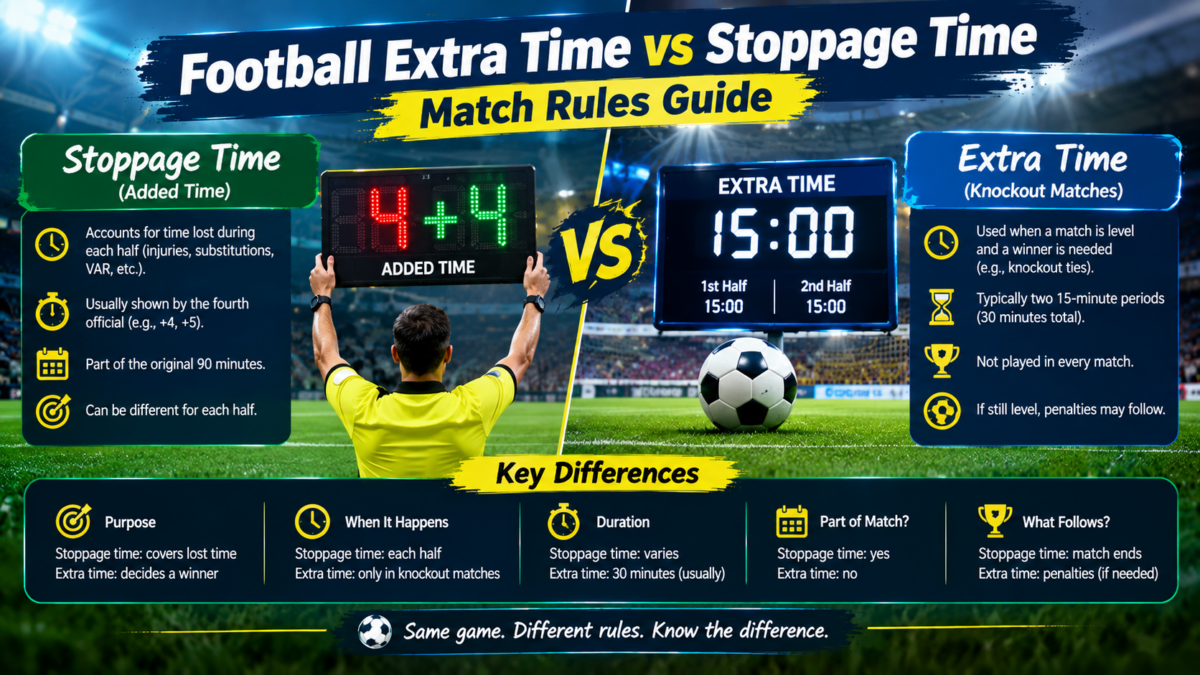
Football matches can become especially exciting when the clock approaches 90 minutes, but the terms stoppage time and extra time often confuse new fans. Although both extend the time played beyond the standard 90 minutes, they serve different purposes and follow different rules.
Understanding the difference helps supporters follow match events, interpret final scores and understand football markets more clearly. For anyone interested in football analysis or football betting, knowing when a match can continue—and what the additional minutes mean—is an important part of understanding the game.
What Is Stoppage Time in Football?
Stoppage time, also called added time or injury time, is the additional time played at the end of each half to account for delays during normal play. A standard football match has two 45-minute halves, but the referee may allow additional minutes when playing time has been lost.
According to IFAB Law 7: The Duration of the Match, the referee accounts for delays caused by substitutions, injuries, disciplinary action, goal celebrations, time-wasting and VAR checks or reviews.
For example, if the referee indicates five minutes of added time at the end of the second half, play continues beyond the 90-minute mark. The referee can increase that allowance if further delays occur, but the indicated minimum cannot be reduced.
Stoppage time is part of the original match, not a separate period of play. It can also be added at the end of the first half.
What Is Extra Time in Football?
Extra time is an additional playing period used in certain competitions when a match or knockout tie must produce a winner and the score remains level after normal time. Unlike stoppage time, extra time is not automatically played in every match.
In many knockout competitions, extra time consists of two 15-minute periods, giving teams up to 30 additional minutes. A short interval may separate the end of normal time from the start of extra time, according to the competition regulations.
For example, UEFA’s European Championship regulations specify two 15-minute periods for relevant knockout matches that remain level after normal time. If the teams are still tied after extra time, a penalty shoot-out determines the winner.
However, competition formats vary. Some matches go directly to penalties after normal time, so fans should check the rules of the specific tournament.
Key Differences Between Extra Time and Stoppage Time
The main difference is their purpose. Stoppage time compensates for time lost during a half, while extra time provides additional playing periods to help determine a winner when competition rules require it.
| Feature | Stoppage Time | Extra Time |
| Main purpose | Compensates for lost playing time | Helps decide a tied knockout match or tie |
| When it happens | At the end of each half | After normal time when competition rules require it |
| Typical duration | Set by the referee based on lost time | Often two 15-minute periods |
| Applies to every match? | Generally, when time has been lost | No |
| Part of normal time? | Yes | No, it is a separate additional period |
| What follows? | The half or match ends | Penalties may follow if the score remains level |
These differences matter because a goal scored during stoppage time is still scored during normal time. A goal scored during extra time is recorded as an extra-time goal, although its treatment in statistics and betting markets depends on the applicable rules.
How Does the Referee Decide Stoppage Time?
The referee considers the time lost through interruptions during the half. Common examples include:
- Substitutions: Time taken for players to leave and enter the pitch.
- Injuries: Delays for medical assessment or the removal of injured players.
- VAR reviews: Time used to review potential incidents or decisions.
- Goal celebrations: Delays after a team scores.
- Time-wasting: Deliberate delays to restarts or other interruptions.
- Disciplinary incidents: Time lost when the referee deals with cautions or dismissals.
The fourth official usually displays the minimum added time on the electronic board. The referee remains responsible for timekeeping and may allow more time if further interruptions occur.
This means that a match showing five minutes of stoppage time does not necessarily end at exactly 95:00. Additional delays can extend the period.
How Extra Time Can Change a Match
Extra time places additional physical and tactical demands on both teams. Players may already be tired after 90 minutes, making concentration, substitutions and defensive organisation especially important.
A team that has defended successfully throughout normal time may become vulnerable to mistakes. Meanwhile, a side with fresh attacking substitutes may find opportunities to create chances late in the game.
Coaches often adjust their approach based on the situation. Some teams press aggressively to score early in extra time, while others prioritise possession and avoid taking unnecessary risks. If neither team gains the advantage, a penalty shoot-out may decide the outcome.
For fans following match statistics, it is also important to distinguish between a result after 90 minutes and the final result after extra time or penalties.
Why the Difference Matters in Football Betting
Different football markets can use different settlement rules. A standard match-result market commonly refers to the score after 90 minutes plus stoppage time, excluding extra time and penalty shoot-outs unless the market rules state otherwise.
Other markets may specifically cover qualification, including extra time and penalties. Goalscorer, total-goals and other selections can also have rules that vary by provider and market type.
Before placing a selection, read the market description and settlement conditions carefully. For instance, a team that scores in extra time may win the knockout match but may not count as the winner of a 90-minute match-result market.
For general information about football markets and match formats, readers can visit the football betting section on Cricbet99. Understanding the rules helps readers interpret the market correctly; it does not guarantee a particular outcome.
FAQs
1. Is stoppage time the same as injury time?
Yes. Injury time is a commonly used name for stoppage time, although added time can account for delays beyond injuries, including substitutions, VAR reviews and goal celebrations.
2. Is extra time always 30 minutes?
No. In many knockout competitions, extra time consists of two 15-minute periods. However, not every competition uses extra time, and some formats proceed directly to penalties after normal time.
3. Can a referee extend stoppage time?
Yes. The referee can increase the indicated minimum when further time is lost during stoppage time. The displayed allowance is a minimum rather than an exact finishing time.
4. Does a goal in stoppage time count as a normal-time goal?
Yes. Stoppage time remains part of the relevant half, so a goal scored during it counts as part of normal time.
5. Do goals in extra time count in football betting markets?
It depends on the market’s settlement rules. A 90-minute match-result market usually excludes extra time, while qualification markets may include extra time and penalties. Always check the specific terms.
Final Thought
Stoppage time and extra time both allow football to continue beyond the usual 90 minutes, but they have different purposes. Stoppage time accounts for interruptions during normal play, while extra time is used in certain competitions to help decide a winner when a match remains level.
Knowing these rules makes match reports, tournament formats and football statistics easier to understand. It also helps readers interpret market descriptions more carefully and avoid confusing a 90-minute result with the eventual outcome of a knockout match.