How Winning Team & Both Teams to Score Markets Work

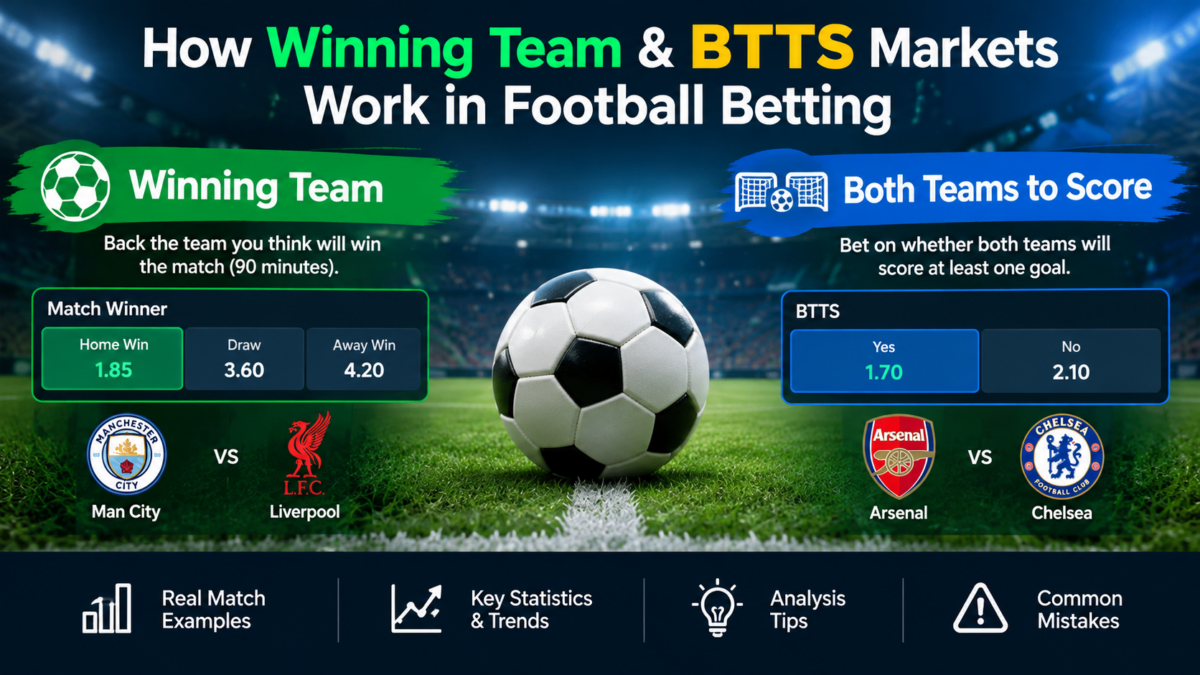
Football betting offers much more than simply predicting which team will win a match. Two markets that beginners often come across are the Winning Team market and Both Teams to Score (BTTS) market. While both are based on what happens during a football match, they focus on different outcomes.
The Winning Team market is about predicting the side that will finish with more goals, while BTTS focuses on whether both teams can score at least once. Understanding the difference between these markets can make football betting easier to follow and help bettors make decisions based on match data rather than guesswork.
What Is the Winning Team Market?
The Winning Team market is one of the simplest football betting markets. The prediction is based on the final result of the match.
Usually, there are three possible selections:
- Home team to win
- Draw
- Away team to win
According to the official Laws of the Game, the team that scores more goals is the winner. If both teams score the same number of goals, the match is a draw.
For example, imagine a match between Team A and Team B.
If the final score is:
Team A 2–1 Team B
A selection on Team A to win would be successful.
If the score finishes:
Team A 1–1 Team B
The match result is a draw.
This makes the market straightforward, but predicting the winner still requires careful analysis.
What Should You Check Before Choosing a Winning Team?
A team’s position in the league table is useful, but it should not be the only factor.
Recent form can provide a better picture of how a team is performing. Look at the results from the last five or six matches and consider whether the team is consistently creating chances and scoring goals.
Home and away records are also important. Some teams perform strongly in front of their home supporters but struggle when playing away.
Other factors worth checking include:
- Recent goals scored and conceded
- Injuries and suspensions
- Expected goals (xG)
- Home and away performance
- Head-to-head trends
- Likely starting line-ups
- Tactical approach
- Fixture congestion
Using several factors together can provide a more balanced view than simply choosing the team with the bigger reputation.
What Does Both Teams to Score Mean?
Both Teams to Score, commonly shortened to BTTS, is a goal-based market.
Instead of predicting the winner, you are predicting whether both sides will score at least one goal during the match.
The two basic choices are:
BTTS – Yes: Both teams score at least one goal.
BTTS – No: At least one team fails to score.
For example, if the final score is 2–1, BTTS – Yes is successful because both teams scored.
If the match finishes 3–0, BTTS – No is successful because one team failed to score.
The final winner does not matter for a standard BTTS selection. A 1–1 draw and a 3–2 home win can both produce a winning BTTS – Yes outcome. BTTS is generally settled according to the goals scored by both teams, with individual bookmaker rules determining details such as abandoned matches and the applicable playing period.
How to Analyse a BTTS Market
BTTS analysis is mostly about identifying whether both teams have a realistic chance of finding the net.
Start by checking each team’s recent scoring record. A side that regularly scores at home can be particularly interesting when facing an opponent that also has a strong attacking record.
Defensive statistics matter just as much.
A team may score regularly but also concede frequently. That combination can sometimes make a BTTS market more relevant than a simple match-winner prediction.
Expected Goals can also add another layer to the analysis. xG measures the quality of chances created rather than simply counting goals. Comparing attacking and defensive xG can help identify whether recent results accurately reflect a team’s underlying performance.
However, statistics should be treated as information rather than guarantees. Football matches can change quickly because of an early red card, injury, tactical adjustment or unexpected individual performance.
Winning Team vs BTTS: What Is the Difference?
The biggest difference is the question each market asks.
The Winning Team market asks:
Which team will score more goals?
BTTS asks:
Will both teams score at least once?
Consider three examples:
Example 1: 2–0
- Home team wins
- BTTS – No
Example 2: 1–1
- Draw
- BTTS – Yes
Example 3: 3–2
- Home team wins
- BTTS – Yes
This shows why the two markets can produce very different betting decisions.
A strong favourite does not automatically make BTTS – Yes attractive. The favourite could win comfortably while keeping a clean sheet. Similarly, two evenly matched teams do not necessarily guarantee a high-scoring game.
Can Winning Team and BTTS Be Combined?
Some football betting platforms offer combination markets such as Winning Team & Both Teams to Score.
Here, two conditions have to be correct.
For example:
Team A to Win + BTTS – Yes
For the selection to succeed, Team A must win and Team B must also score.
A 2–1 result would satisfy both conditions.
A 2–0 result would not, because Team B failed to score.
Combination markets can therefore be more specific than standard match-result or BTTS selections. Official sportsbook rules also list result-and-BTTS combinations as a distinct market type.
Common Mistakes to Avoid
One common mistake is relying too heavily on a team’s name or reputation.
A famous club can still concede goals or struggle away from home. Another mistake is looking only at the previous match. One result rarely provides enough information to judge a team’s overall attacking or defensive strength.
It is also important not to confuse a high-scoring league with a guaranteed BTTS outcome. Even in attacking competitions, some matches finish with one team failing to score.
Another mistake is ignoring team news. Missing forwards, defensive injuries or changes in the goalkeeper can affect the match significantly.
For anyone interested in Football Betting, understanding these basic markets is a useful starting point before looking at more specialised options.
How Responsible Analysis Can Improve Decisions
No betting market can guarantee a winning result. The aim of analysis should be to understand the possible outcomes and make decisions based on available information.
A simple process can help:
- Check recent team form.
- Compare home and away records.
- Review goals scored and conceded.
- Check important player absences.
- Look at attacking and defensive statistics.
- Consider the tactical matchup.
- Understand the market rules before placing a bet.
- Set a fixed betting budget and avoid chasing losses.
This approach keeps the focus on research instead of emotion.
Frequently Asked Questions
What is the Winning Team market?
The Winning Team market involves predicting which side will finish a football match with more goals. Depending on the market, a draw may also be available as a selection.
What does BTTS mean in football betting?
BTTS stands for Both Teams to Score. The standard market asks whether both teams will score at least one goal during the match.
Does a 1–1 score win BTTS?
Yes. A 1–1 result means both teams have scored, so BTTS – Yes would be successful under standard market rules.
Does a 2–0 score win BTTS – Yes?
No. Only one team scored, so a standard BTTS – Yes selection would lose.
Can a team win and BTTS also be successful?
Yes. For example, a 2–1 or 3–1 result means one team wins while both teams score.
What statistics are useful for BTTS analysis?
Recent goals scored and conceded, home and away records, player availability, attacking form and expected goals can all be useful when assessing a BTTS market.
Is BTTS easier to predict than the match winner?
Not necessarily. BTTS and match-winner markets measure different outcomes. The better option depends on the specific teams, match conditions and available information.
Final Thought
The Winning Team and Both Teams to Score markets look simple, but making an informed selection requires more than checking the league table. The Winning Team market focuses on which side scores more, while BTTS focuses on whether both sides can find the net.
Recent form, attacking numbers, defensive weaknesses, home and away records, team news and xG can all help provide a clearer picture. Official football rules also provide the foundation for understanding how goals and match results are determined.
The key is to understand exactly what a market requires before making a selection. Football remains unpredictable, so responsible betting, sensible limits and proper research should always come before chasing a particular outcome.