How Football Draw Markets Work

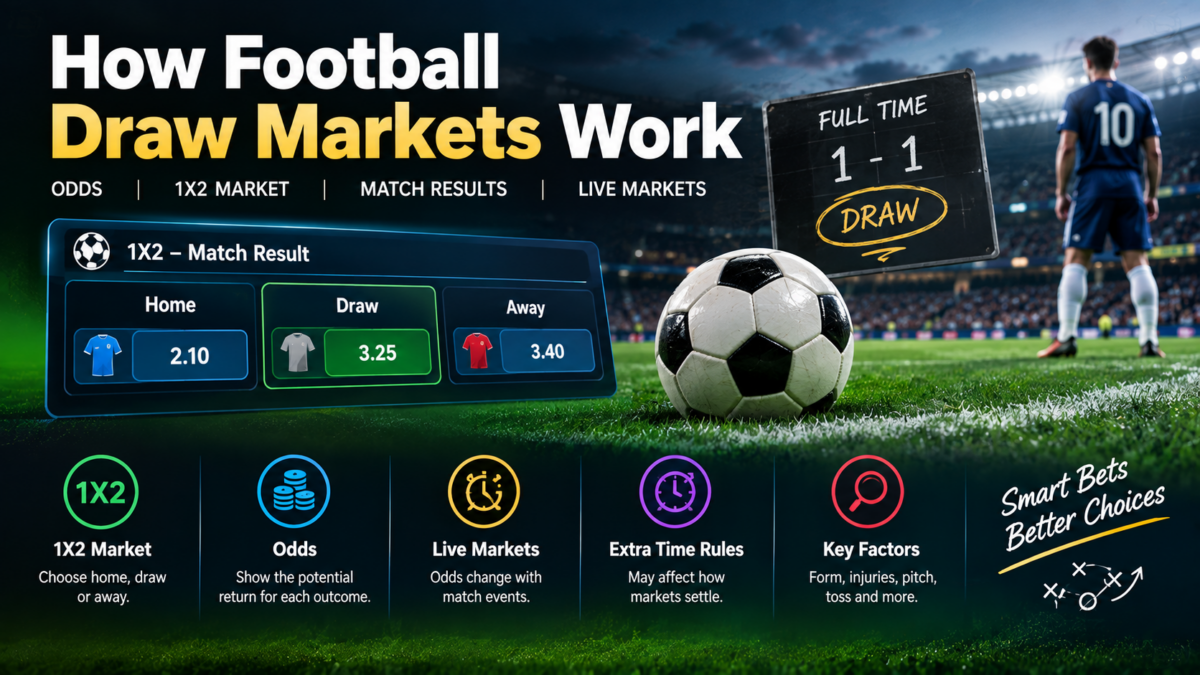
Football is often described as a game of two sides, but betting markets can offer more than simply choosing the home or away team. One of the most common options is the draw market, which gives users a third possible match result.
Understanding how football draw markets work is important because a draw is not simply about guessing that both teams will score the same number of goals. The market also has specific settlement rules, odds, match conditions, and competition formats that can affect how the final result is treated.
For anyone comparing different football betting markets, understanding the draw option provides a useful foundation before looking at more specialised selections.
What Is a Football Draw Market?
A football draw market is based on the possibility that both teams finish a match with the same number of goals.
For example, if a league match between Team A and Team B finishes 1–1, the match result is a draw. A 0–0, 2–2, or 3–3 scoreline can also result in a draw.
In a standard match-result market, there are usually three selections:
- Home team to win
- Draw
- Away team to win
This is commonly known as the 1X2 market, where 1 represents a home win, X represents a draw, and 2 represents an away win.
The important point is that the draw is a separate outcome rather than a combination of the two teams.
How Draw Odds Work
Draw odds indicate the potential return attached to the draw selection. Like other football markets, odds can be displayed in decimal, fractional, or American formats depending on the sportsbook.
For example, if the draw is listed at decimal odds of 3.20 and a user places a ₹500 stake, the potential total return would be:
₹500 × 3.20 = ₹1,600
The potential profit would therefore be ₹1,100, excluding any applicable conditions.
Odds do not guarantee an outcome. They represent the current pricing of the market and can change as new information becomes available.
Cricbet99’s football section notes that odds can move because of factors such as team news, injuries, line-ups, recent results, and events during the match.
Why Do Draw Odds Change?
Football draw odds can change before kick-off and, where in-play markets are available, during the match.
Several factors can influence these movements.
Team Form
Recent results can provide useful context. Two teams that regularly produce closely contested matches may attract different draw pricing compared with a fixture where one side has been consistently dominant.
However, recent form should be considered alongside the quality of the opposition rather than viewed in isolation.
Home and Away Performance
Some teams perform differently depending on where they play. A strong home side facing a competitive visiting team may create a different draw scenario from two teams with similar home and away records.
Injuries and Suspensions
The absence of an important striker, midfielder, goalkeeper, or defender can affect a team’s approach and expected performance.
Late team news can therefore cause draw prices to move before the match begins.
Tactical Approach
Playing style can also influence expectations. Teams that prefer controlled possession and defensive organisation may produce different match patterns from sides that consistently play attacking football.
Tactical changes can become especially important when both teams are closely matched.
How Live Draw Markets Work
A live draw market operates after the match has started, when available.
Unlike a pre-match market, live odds respond to events happening on the pitch. A goal can immediately change the price of a draw because the scoreline has changed.
For example, if a match is 0–0 after 70 minutes, the draw may become increasingly relevant because there is less playing time remaining. However, this does not mean a draw is guaranteed.
A late goal can completely change the result.
Red cards, penalties, substitutions, injuries, and changes in attacking pressure can also influence live market pricing. Cricbet99 similarly notes that live football odds can change with the score, match time, player actions, and other match events.
What Is the Difference Between a Draw and a No Bet Market?
These two markets are often confused, but they work differently.
A standard draw market treats the draw as one of the possible winning outcomes. If the match ends level, the draw selection wins.
A Draw No Bet market works differently. In this type of market, a user selects one team, but if the match ends in a draw, the stake is generally returned according to the market’s rules.
Because settlement conditions can vary between operators and competitions, users should always check the specific market terms before making a selection.
Does Extra Time Count in a Draw Market?
This is one of the most important details to understand.
In normal football, if both teams have scored the same number of goals when the match ends, the match is drawn. IFAB’s Laws of the Game state that a match is drawn when both teams score an equal number of goals.
However, knockout competitions can have different procedures. If competition rules require a winner after a drawn match, extra time and/or a penalty shoot-out may be used to determine which team progresses.
Therefore, the settlement rules of the specific betting market matter. A user should check whether the market is based on the result after 90 minutes plus stoppage time or includes extra time.
Factors to Consider When Reading a Draw Market
Understanding the market is different from trying to predict its result. Football remains unpredictable, but several pieces of information can help provide context.
Recent Results
Look beyond one or two matches and consider a team’s broader recent record.
Goals Scored and Conceded
Teams with similar scoring and defensive records may produce a different match profile from a fixture involving a high-scoring attack and a struggling defence.
League Position
The league table can provide context, but position alone does not explain everything about a particular fixture.
Head-to-Head Results
Previous meetings may provide background information, although old results may have limited relevance when squads, managers, and tactics have changed.
Confirmed Line-Ups
Starting line-ups can reveal important information about attacking and defensive strength before kick-off.
Match Importance
A fixture involving relegation pressure, European qualification, or a title race may have a different tactical approach from a match with fewer competitive consequences.
Common Mistakes When Looking at Draw Markets
One common mistake is assuming that a close-looking match will automatically end in a draw. Even evenly matched teams can produce a clear winner after one early goal changes the game.
Another mistake is focusing only on the odds without checking the underlying match information.
It is also important not to confuse a draw after regular time with a competition winner determined after extra time or penalties. The applicable market rules should always be checked before participation.
Most importantly, betting should not be treated as guaranteed income. Users should set a realistic budget, avoid chasing losses, and participate only where permitted by applicable local laws.
Frequently Asked Questions
What is a draw market in football?
A draw market is a betting option where the selected outcome is that both teams finish the match with the same number of goals.
What does X mean in football betting?
In a traditional 1X2 market, X represents a draw. The number 1 represents a home win, while 2 represents an away win.
Can a 0–0 match count as a draw?
Yes. If both teams finish with zero goals, the match is drawn under the normal Laws of the Game.
Do draw odds change during a match?
Yes. When live markets are available, draw odds can change as the score, remaining time, cards, substitutions, and other match events develop.
Does a penalty shoot-out count for a draw market?
It depends on the specific market rules. In competitions where penalties are used to determine a winner, users should check whether the market is settled on the result after normal time or after extra time and penalties.
What factors can influence draw odds?
Team form, injuries, starting line-ups, home and away performance, tactical approach, scoring records, and live match events can all influence draw pricing.
Final Thought
Football draw markets offer a straightforward third option alongside home and away wins, but understanding the market requires attention to more than the final score. Odds, team news, tactical approaches, match conditions, and settlement rules can all affect how a draw market develops.
The most useful approach is to understand exactly what the market covers before considering any selection. Checking the competition format and settlement conditions is particularly important when a match could go to extra time or penalties.
As with any form of sports betting, football involves uncertainty. Users should stay within a fixed budget, avoid chasing losses, and check the laws and rules that apply in their location.