Understanding Corner Betting Markets in Football: A Practical Guide for Beginners

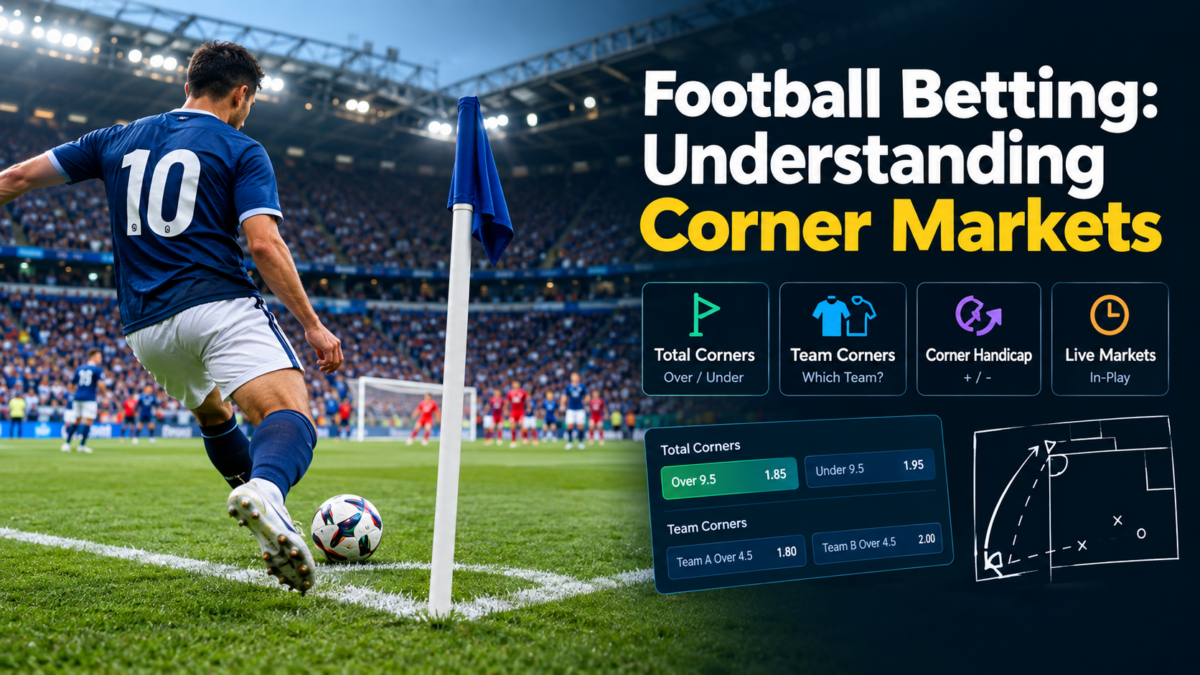
Football betting is often associated with familiar markets such as match winners, both teams to score, and total goals. However, modern sportsbooks also offer a wide range of alternative markets that focus on specific events during a match. One of the most interesting options is the corner betting market in football.
Instead of predicting which team will win, corner markets allow bettors to focus on the number of corners, the team expected to earn more corners, or whether a particular corner line will be reached. Understanding how these markets work can make football statistics easier to interpret and help readers make more informed decisions.
What Are Corner Betting Markets?
A corner kick is awarded when the whole ball crosses the goal line after last touching a defending player, without a goal being scored. The rules and procedure for corner kicks are defined under Law 17 of the official Laws of the Game.
In betting, this event becomes a separate statistical market. Rather than predicting the final score, a bettor studies how frequently teams create attacking situations that can result in corners.
For example, a match may have a market such as:
- Over or under 9.5 total corners
- Team A over 5.5 corners
- Team B to win the corner count
- Handicap on total corners
- First team to reach a specific number of corners
The exact markets available can vary between sportsbooks and competitions.
Why Do Corners Matter in Football?
Corners can provide useful information about a team’s attacking style. A side that spends long periods attacking down the wings, takes frequent shots, or regularly forces defenders to block crosses may generate more corners.
However, possession alone does not automatically mean a team will win the corner count. A team can dominate possession without consistently forcing the ball behind the defensive goal line.
This is why corner statistics should be considered alongside other factors, including:
- Average corners for and against
- Home and away performance
- Recent tactical changes
- Expected line-ups
- Playing style
- Number of attacking players
- Opponent defensive approach
- Match importance
Looking at several factors is generally more useful than relying on one statistic.
Understanding Over and Under Corner Markets
One of the simplest corner markets is the over/under line.
Suppose a sportsbook sets the total corners line at 9.5. An over 9.5 selection requires at least 10 corners during the relevant period, while under 9.5 requires nine or fewer.
The same principle can apply to individual teams. If a team has a line of 4.5 corners, the over selection requires five or more corners.
These markets can look straightforward, but the important part is understanding why the line has been set at that level. Historical averages, team styles and the expected match situation can all influence the market.
What Is a Corner Handicap?
Corner handicaps work in a similar way to other handicap markets, but the adjustment is applied to the corner count rather than the final score.
For example, Team A might be given a -1.5 corner handicap against Team B. In simple terms, Team A would need to finish at least two corners ahead for that selection to succeed.
Handicap markets can be useful when two teams have different attacking profiles but the outright corner market does not fully reflect the expected difference.
Pre-Match vs Live Corner Betting
Corner markets can be available both before kick-off and during a match.
Pre-match analysis usually focuses on historical data, tactical trends and expected line-ups. Live markets provide another layer of information because bettors can observe how the match is actually developing.
For example, if a team is repeatedly attacking through wide areas and forcing blocks or clearances, its corner count may become more relevant during the game.
At the same time, live betting requires caution. A short period of pressure does not necessarily mean the same pattern will continue for the remainder of the match. Game state, substitutions, injuries and a change in tactics can quickly alter the flow.
How to Analyse a Corner Market
A structured approach can make corner analysis more useful.
1. Check Recent Corner Numbers
Look at a team’s recent corner totals, but avoid treating a small sample as a definite trend. A broader selection of matches can provide better context.
2. Compare Home and Away Records
Some teams generate considerably more corners at home than away. The same can apply to corners conceded.
3. Study Tactical Style
Teams that attack through wide areas and deliver frequent crosses may naturally create more corner opportunities. Conversely, teams that prefer central combinations may produce a different statistical profile.
4. Consider the Opponent
Corner statistics are not produced in isolation. A team’s numbers can change depending on the quality and defensive approach of its opponent.
5. Understand the Match Situation
A favourite expected to dominate may generate plenty of corners, but an early goal can completely change the match. The losing side may become more aggressive, while the leading team may become more defensive.
Common Mistakes to Avoid
One of the biggest mistakes in corner betting is assuming that previous results guarantee future outcomes. Football remains unpredictable, and statistics describe patterns rather than certainties.
Another mistake is focusing only on a team’s average corners. It is equally important to examine corners conceded, opponent quality and the tactical context.
It is also worth checking exactly what a market covers before placing any wager. Settlement rules can differ depending on the sportsbook and market type.
Anyone considering football betting should also understand the applicable laws in their location and use only services that are permitted there. Betting should be treated as entertainment rather than a guaranteed way to make money.
FAQs About Corner Betting Markets
What does over 9.5 corners mean?
Over 9.5 corners means the match must produce at least 10 corners for that selection to be successful.
Is corner betting based on the final score?
No. Corner markets are based on corner-related statistics rather than the match result. The specific settlement condition depends on the market selected.
Are corners a good indicator of attacking performance?
They can provide useful information about attacking pressure, but they should not be considered a complete measure of performance. Possession, shots, territory and tactical approach can all provide additional context.
Can corner markets be available during a match?
Yes. Some sportsbooks offer live corner markets, although availability varies by competition, match and platform.
Where can I learn the official rules for corner kicks?
The International Football Association Board (IFAB) publishes the official Laws of the Game, including Law 17: The Corner Kick. Checking the official rules is useful when learning how corner events are defined.
Final Thought
Corner betting markets add another statistical dimension to football. Instead of concentrating only on goals or match winners, they allow analysis of attacking patterns, defensive pressure and how different teams approach a game.
The strongest analysis comes from combining corner averages with tactical information, home-and-away records, opponent characteristics and the expected match scenario. Most importantly, statistics should be used to understand the market rather than to assume a particular result is guaranteed.
For readers exploring different sports markets, football betting can be considered alongside other football-related information and market options available through sports platforms. Always check the applicable local regulations, understand the terms of any market, and maintain responsible betting habits.