First Team to Score Betting Explained: A Complete Football Guide

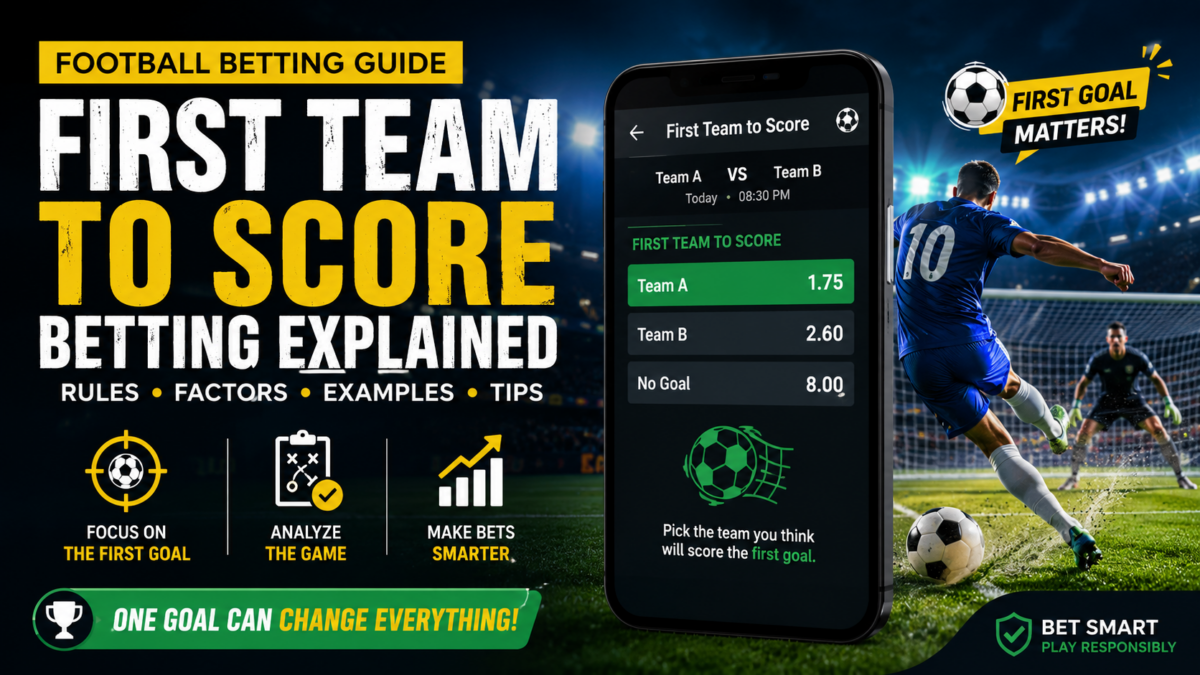
Football betting includes many markets beyond simply predicting which team will win. One of the easiest goal-related markets to understand is First Team to Score Betting. Instead of predicting the final result, this market focuses on one specific question: which team will score the opening goal?
This makes the market different from match-winner, correct-score, and first goalscorer bets. A team can score first and still lose the match, so the final result does not necessarily affect the outcome of a correctly placed first-team-to-score wager.
For anyone learning football betting, understanding how this market works, how it is settled, and which factors can influence the opening goal is a useful starting point.
What Is First Team to Score Betting?
First Team to Score Betting means selecting the team you believe will score the first goal of a football match.
For example, imagine a match between Team A and Team B. The available selections may include:
- Team A to score first
- Team B to score first
- No Goal
If Team A scores in the 18th minute and the match eventually finishes 2-2, a bet on Team A to score first is still successful. The market only concerns the opening goal, not the final score.
A goal is officially awarded when the whole ball passes over the goal line between the posts and under the crossbar, provided there has been no infringement by the scoring team. This is defined under IFAB Law 10.
How Does the First Team to Score Market Work?
The basic process is straightforward. Before the match starts, you select the team you think will score first and check the available odds.
Suppose the market shows:
| Selection | Example Odds |
| Home Team | 1.75 |
| Away Team | 2.60 |
| No Goal | 8.00 |
If you select the Home Team and it scores the opening goal, your selection wins according to the applicable betting rules.
However, if the Away Team scores first, your selection loses. If the match finishes 0-0, the result depends on the bookmaker’s rules. Some operators offer No Goal as a separate selection, while others may have different settlement conditions.
For this reason, checking the specific market rules before placing a bet is important.
Does the Final Result Matter?
No. This is one of the most important things to understand.
First Team to Score Betting is not the same as betting on the match winner. The selected team only needs to score the first goal.
For example:
Bet: Team A to score first
Match: Team A 1-3 Team B
Even though Team A loses the match, the first-team-to-score bet wins if Team A scored before Team B.
Likewise, a team can win 3-1 but lose the first-team-to-score market if the opponent scored the opening goal.
This simple distinction makes the market appealing to bettors who want to focus on the early scoring pattern rather than the full 90-minute result.
What Happens If the Match Ends 0-0?
A goalless match is an important situation in this market.
Some bookmakers provide No Goal as a third selection. If the game ends 0-0 during the relevant playing period, a No Goal selection can be the winning outcome.
However, settlement rules are not identical across every sportsbook. For example, the Hong Kong Jockey Club lists Home Team, Away Team, and No Goal as selections and states that its First Team to Score bets are settled on playing time, excluding extra time and penalty shootouts.
Therefore, always check the rules of the sportsbook you are using rather than assuming every operator handles a 0-0 result in exactly the same way.
Do Own Goals Count?
Own goals are another area where bettors should pay attention to the rules.
For team-level first-to-score markets, an own goal can count in favour of the team that is credited with the goal. The HKJC’s football rules specifically state that an own goal is counted for the team accredited with the goal in its First Team to Score market.
This is different from some player-based goalscorer markets, where own goals can be treated differently.
The safest approach is to read the settlement rules for the exact market before betting.
Factors to Consider Before Choosing a Team
Although there is no guaranteed method for predicting the opening goal, several factors can help with match analysis.
Recent Scoring Form
Look at how frequently each team has scored first in recent matches. A side that regularly starts strongly may deserve closer attention.
However, avoid relying on a small sample alone. Recent results should be considered alongside the quality of opposition and home or away conditions.
Home and Away Performance
Some teams perform differently depending on the venue. A club may create more chances at home but play more cautiously away.
Comparing home scoring records with the opponent’s away defensive record can provide additional context.
Starting Lineups
Team news can have a major impact on the first-goal market. Missing forwards, creative midfielders, or important defenders may change the expected balance of a match.
Checking confirmed lineups before kickoff can therefore be useful, particularly when betting close to the start time.
Tactical Approach
Some teams press aggressively from the opening whistle, while others prefer to control possession and gradually increase the tempo.
A high-pressure approach can create early chances, but it can also leave defensive spaces. Understanding each team’s usual tactical style is more useful than simply looking at league position.
Defensive Weaknesses
A team that frequently concedes early goals may be vulnerable in this market. Look at when goals are usually conceded rather than considering only the overall number of goals allowed.
First Team to Score vs First Goalscorer
These two markets are easy to confuse.
First Team to Score: You predict which team scores the opening goal.
First Goalscorer: You predict the individual player who scores the opening goal.
If Team A scores first through a defender, a first-team-to-score bet on Team A can win regardless of which player scored. A first-goalscorer selection, on the other hand, depends on correctly identifying the player under the applicable rules.
This makes the team market less dependent on one specific player’s finishing ability.
First Team to Score in Live Betting
The market can also appear during a match, depending on the sportsbook.
Live betting can be more complicated because the odds change as the game develops. A team that was favoured before kickoff may become less attractive after a poor start, while the opposing side’s price may move in the other direction.
If considering live markets, pay attention to possession, chances created, injuries, red cards, and tactical changes rather than reacting only to the current score.
Responsible betting also means setting a budget and avoiding decisions based on emotions after an early goal.
Why This Market Is Popular
The main attraction of First Team to Score Betting is its simplicity.
You do not need to predict:
- The final score
- The match winner
- The number of goals
- The winning margin
- Which individual player will score
You only need to identify which team is likely to score first.
That narrower question can make the market easier to understand, particularly for newcomers to football betting.
For those comparing different football betting markets, the first-team-to-score option can sit alongside traditional match-result and goal-total markets.
Common Mistakes to Avoid
One common mistake is assuming that the team most likely to win must automatically be the best first-to-score selection. A strong favourite can concede first and recover later.
Another mistake is ignoring the opponent’s attacking strength. First-goal analysis should consider both teams rather than focusing entirely on one side.
It is also important not to treat historical head-to-head results as a guarantee. Football matches change because of different managers, players, tactics, injuries, and current form.
Finally, never assume that every bookmaker uses identical settlement rules. Details involving 0-0 matches, abandoned games, extra time, and own goals can vary.
FAQs About First Team to Score Betting
What does First Team to Score mean?
It means predicting which team will score the opening goal of a football match.
Does the team have to win the match?
No. The selected team only needs to score first. It can still lose the match later.
What happens if the match finishes 0-0?
It depends on the sportsbook’s rules. Some markets include No Goal as a separate selection, while other operators may have different settlement conditions.
Do own goals count?
For many team-level markets, an own goal is credited to the team that benefits from it. Always check the specific sportsbook rules.
Can First Team to Score be used in live betting?
Yes, where the sportsbook offers the market during play. Live odds can change quickly as match events develop.
Is First Team to Score the same as First Goalscorer?
No. First Team to Score asks which team scores first, while First Goalscorer asks which individual player scores first.
Final Thought
First Team to Score Betting is one of the simpler football betting markets because it focuses on a single event: the opening goal. Understanding the difference between scoring first and winning the match is essential, as is checking the sportsbook’s settlement rules for situations such as 0-0 draws, own goals, and extra time.
Good analysis should combine recent scoring patterns, home and away performance, team news, tactical approach, and defensive trends rather than relying on one statistic. Used responsibly, this market can be an interesting way to follow football while keeping the betting question focused on the game’s first major scoring event.