First Half Result vs Full-Time Result Betting: What’s the Difference?

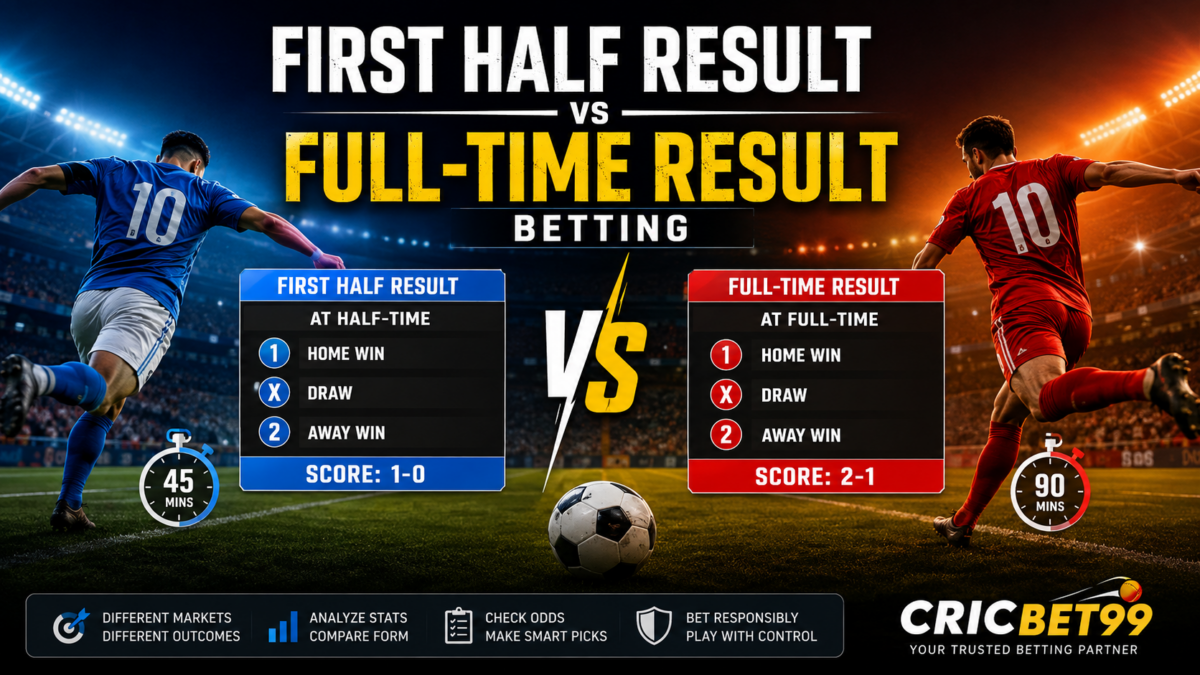
Football betting offers several markets that look similar at first but are settled at different stages of a match. Two of these are First Half Result and Full-Time Result betting. Understanding the difference between them is important because a team that leads at half-time does not necessarily finish the match as the winner.
A standard football match consists of two 45-minute halves, with additional time added by the referee for stoppages. The International Football Association Board (IFAB) sets these basic match-duration rules.
For bettors comparing different football markets, knowing exactly when a selection is settled can make the market much easier to understand.
What Is First Half Result Betting?
First Half Result betting focuses only on the score at the end of the first half.
The most common options are:
- 1 – Home team is leading at half-time
- X – The score is level at half-time
- 2 – Away team is leading at half-time
For example, suppose a match reaches half-time with the home team leading 1–0. A First Half Result selection on the home team would be successful, regardless of what happens after the interval.
If the same match eventually ends 1–2, the first-half selection can still be successful because the home team was ahead when the first half ended.
This makes the market different from a traditional full-match result bet.
What Is Full-Time Result Betting?
Full-Time Result betting is based on the result at the end of normal playing time.
Again, the three standard selections are:
- 1 – Home team wins
- X – Match ends in a draw
- 2 – Away team wins
For example, if the home side leads 2–0 at half-time but the visitors come back to win 3–2, a Full-Time Result selection on the home team would lose.
The key point is simple: First Half Result is settled on the half-time score, while Full-Time Result is settled on the final score according to the applicable betting rules.
First Half Result vs Full-Time Result
The easiest way to understand the difference is to look at how one match can produce different outcomes in the two markets.
Imagine the following match:
Half-time: Team A 1–0 Team B
Full-time: Team A 1–2 Team B
In this situation:
| Betting Market | Result |
| First Half Result – Team A | Winning selection |
| First Half Result – Draw | Losing selection |
| Full-Time Result – Team A | Losing selection |
| Full-Time Result – Team B | Winning selection |
The example shows why bettors should not assume that a strong first-half performance automatically indicates a full-time win.
Football matches can change dramatically after the break because of substitutions, tactical adjustments, injuries, red cards and changes in momentum.
Why Can the Two Results Be So Different?
One of the biggest reasons is that football is a game of changing momentum.
A team may dominate the opening 45 minutes, score early and protect its advantage. However, the opposition may change its formation at half-time and become more aggressive in the second half.
The opposite can also happen. A team may start slowly, go into half-time behind and then recover after the break.
This is why historical first-half and full-time performance can provide different information when assessing a match.
For example, a team might regularly score early but concede more goals during the second half. Another side could have a reputation for improving after half-time. These patterns can be useful when comparing markets, although past performance does not guarantee a future result.
What Should Bettors Check Before Choosing a Market?
Understanding the market is only the first step. Match context is equally important.
1. Recent First-Half Performance
Check how often each team leads, draws or trails at half-time in recent matches. A side with a strong record in the opening 45 minutes may be more relevant to First Half Result markets.
2. Full-Time Results
Look separately at recent final results. A team may be effective at maintaining early leads, while another may regularly recover from difficult positions.
3. Home and Away Form
Home and away records can be significantly different. A team that performs well at home may approach matches differently when playing away.
4. Lineups and Injuries
Starting lineups can influence the expected flow of a game. Missing forwards, midfielders or defenders can change how a team approaches both halves.
5. Tactical Approach
Some managers prefer aggressive starts, while others focus on controlling possession and gradually increasing pressure. Understanding the tactical setup can provide useful context.
How First Half and Full-Time Markets Can Be Compared
Rather than viewing the two markets as interchangeable, think of them as separate questions.
First Half Result asks:
“Who will be ahead, or will the match be level, when the first half ends?”
Full-Time Result asks:
“Which team will have the better result when normal playing time is complete?”
This distinction becomes particularly useful when researching matches where one side tends to start strongly but struggles to maintain its advantage.
For readers looking at broader football betting information and related match markets, a Cricbet99 ID Provider can also be considered as part of the wider process of finding relevant betting resources. Any betting activity should be approached responsibly and in accordance with local laws and platform rules.
A Simple Example of Market Selection
Consider a fictional match between Manchester United and Chelsea.
Suppose the expected score at half-time is 0–0, but Chelsea has a stronger record of scoring in the second half.
A bettor comparing the two markets might reach very different conclusions:
- First Half Result: Draw
- Full-Time Result: Chelsea
- Correct Score: 0–1 or 1–2
These are separate markets, so each requires its own assessment.
The important lesson is not to treat a first-half prediction as automatically connected to the full-time result.
Why Understanding Settlement Rules Matters
Betting markets can have specific settlement conditions, particularly around abandoned matches, extra time, postponed fixtures and other unusual situations.
For standard football matches, the game is played over two 45-minute halves, while the referee allows additional time for delays and stoppages.
Different betting operators can also publish their own market-specific rules. Therefore, checking the applicable rules before placing a wager is a sensible step.
Official football resources are useful for understanding the underlying laws of the game. FIFA also directs users to the IFAB for questions concerning the Laws of the Game.
Responsible Approach to Football Betting
Football betting involves financial risk, and no statistical method can guarantee a winning result. Even a team with excellent recent form can lose because of an unexpected tactical change, injury, sending-off or moment of individual quality.
FIFA also highlights the importance of protecting football’s integrity and warns against match manipulation and betting-related misconduct.
A sensible approach is to treat betting as entertainment, set a clear budget and avoid chasing losses.
FAQs
Is First Half Result the same as Full-Time Result?
No. First Half Result is based on the score at the end of the first half, while Full-Time Result is based on the match result at the end of normal playing time under the relevant betting rules.
What does 1X2 mean in football betting?
1X2 is a common three-way result market. “1” represents a home win, “X” represents a draw and “2” represents an away win.
Can a team win the First Half Result but lose the Full-Time Result?
Yes. A team can lead at half-time and then concede goals after the break. For example, a 1–0 half-time lead can become a 1–2 full-time defeat.
Does extra time normally count for Full-Time Result betting?
This depends on the specific market and its rules. Many standard match-result markets are settled on normal time, excluding extra time and penalty shootouts. Always check the applicable betting rules before placing a wager.
Which market is easier to predict?
Neither market is guaranteed to be easier. First Half Result requires analysis of the opening 45 minutes, while Full-Time Result considers the complete match. Team form, tactics, lineups and match circumstances can affect both.
Final Thought
First Half Result and Full-Time Result may appear similar, but they measure two different stages of a football match. A team can dominate the opening period without securing three points, while another side can recover after half-time and completely change the final outcome.
Understanding the settlement point, studying first-half and full-time trends separately, checking team news and reviewing the relevant market rules can help create a clearer approach to football betting. Most importantly, predictions should be treated as probabilities rather than guarantees, with responsible betting always taking priority.