Aryna Sabalenka’s Path to the Wimbledon Final: Biggest Obstacles Remaining

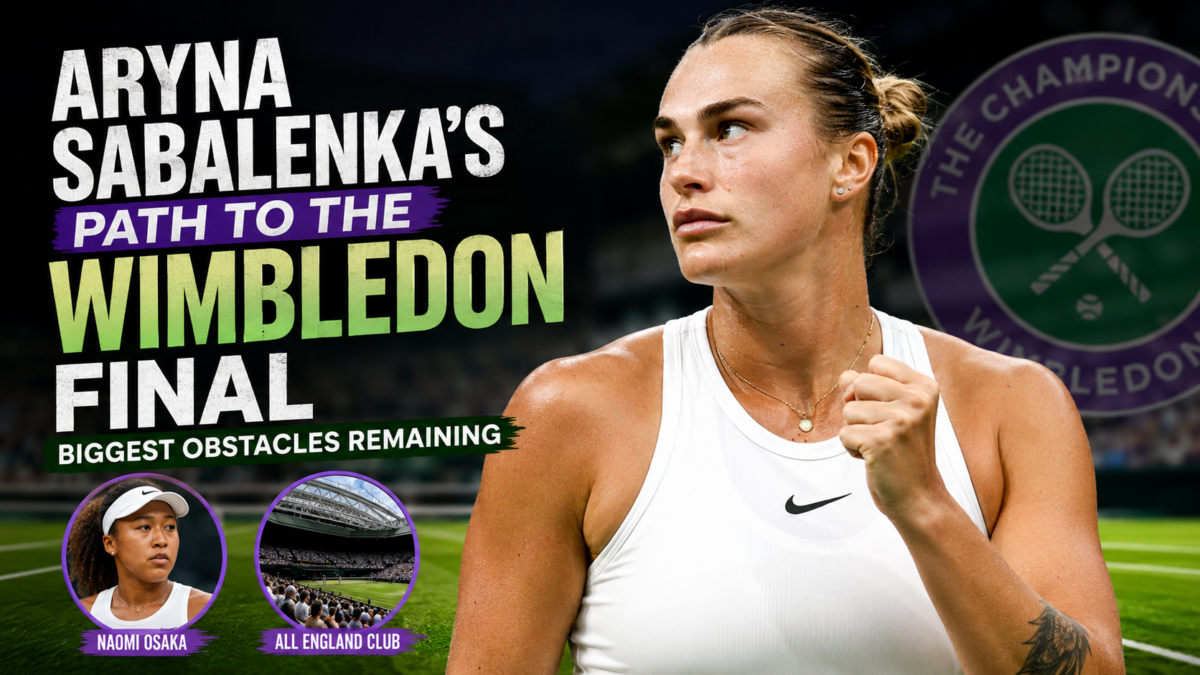
Aryna Sabalenka’s Path to the Wimbledon Final: Biggest Obstacles Remaining
Aryna Sabalenka entered Wimbledon 2026 carrying the weight of expectation. As the world No. 1, she was considered the strongest favorite to capture her maiden Wimbledon title after several deep runs at the All England Club. With early exits from several top contenders, the draw appeared to be opening perfectly for the Belarusian.
However, Grand Slam tournaments rarely follow the script.
Sabalenka’s impressive run came to an unexpected end in the fourth round when former world No. 1 Naomi Osaka produced one of the biggest upsets of the tournament. The result not only ended Sabalenka’s championship dream but also transformed the entire women’s draw.
Why Sabalenka Was the Favorite
Before Wimbledon began, Sabalenka’s form suggested she was ready to conquer grass. She had already enjoyed an outstanding 2026 season with strong performances on hard courts and continued consistency across major tournaments.
Her powerful serve, aggressive baseline game, and improved movement made her one of the toughest opponents on any surface. Wimbledon had previously been a tournament where she reached multiple semi-finals but never lifted the trophy. This year looked like her best opportunity.
As the tournament progressed, several major contenders exited earlier than expected, making Sabalenka the clear player to beat.
A Strong Opening Week
Sabalenka looked comfortable during the opening rounds.
She handled difficult moments with confidence, particularly against McCartney Kessler, where she recovered after facing multiple set points in the second set. That comeback highlighted her resilience under pressure.
Her third-round victory over Jelena Ostapenko was arguably her most complete performance of the tournament. Sabalenka dominated with controlled aggression, serving efficiently while limiting unforced errors.
After that win, many analysts believed she had finally found the perfect balance between power and patience on grass.
The Biggest Remaining Obstacle Was Naomi Osaka
The projected route to the Wimbledon final looked manageable on paper.
Instead, Naomi Osaka produced one of her finest performances since returning to professional tennis.
Osaka immediately took control of the match with fearless shot-making and exceptional serving. She dictated rallies early and prevented Sabalenka from establishing her usual aggressive rhythm.
The first set quickly slipped away from the top seed, and although Sabalenka fought harder in the second set, Osaka remained composed during the tiebreak to complete a straight-set victory.
One remarkable statistic underlined the significance of the result—Osaka snapped Sabalenka’s remarkable 21-match Grand Slam tiebreak winning streak.
What Went Wrong for Sabalenka?
Several factors contributed to Sabalenka’s defeat.
Inconsistent First Serve
Sabalenka relies heavily on free points behind her serve. Against Osaka, her first-serve percentage dropped at crucial moments, allowing Osaka to attack second serves aggressively.
Unforced Errors
Normally, Sabalenka balances risk with controlled aggression. This time, too many forehand mistakes allowed Osaka to gain confidence throughout the match.
Osaka’s Elite Returning
Osaka read Sabalenka’s serve exceptionally well. Instead of simply defending, she consistently turned return games into attacking opportunities.
Momentum Shift
After losing the opening set comfortably, Sabalenka never fully regained momentum. Osaka maintained scoreboard pressure from start to finish, forcing the world No. 1 into uncomfortable positions.
The Draw Opened Up After the Upset
Sabalenka’s elimination dramatically changed Wimbledon 2026.
Instead of facing the tournament favorite, the remaining players suddenly saw an opportunity to reach the final.
Osaka advanced to the quarter-finals before eventually losing to Karolina Muchova, who used her variety, movement, and net play to end Osaka’s impressive run. Meanwhile, Coco Gauff also continued her strong campaign to reach the semi-finals, highlighting just how competitive the women’s draw had become.
The tournament ultimately guaranteed another first-time women’s Wimbledon champion, showing how unpredictable Grand Slam tennis can be.
Lessons Sabalenka Can Take Forward
Despite the disappointment, Sabalenka’s Wimbledon campaign offered several positives.
She once again proved she can consistently reach the latter stages of major tournaments and remains one of the most complete players on the WTA Tour.
Her improved movement on grass, stronger defensive skills, and willingness to construct points rather than relying solely on power suggest she is becoming an even more dangerous all-court player.
The loss to Osaka also exposed areas that can still improve:
- Higher first-serve consistency under pressure.
- Better shot selection during momentum swings.
- Greater adaptability against elite returners.
Given her age and current level, there is every reason to believe Sabalenka will remain among the favorites for future Wimbledon titles.
What This Means for Women’s Tennis
Sabalenka’s defeat reinforces how competitive women’s tennis has become.
Unlike previous eras dominated by one or two players, today’s WTA Tour features several legitimate Grand Slam contenders capable of defeating the world’s best on any given day.
Osaka’s victory demonstrated that rankings alone do not determine outcomes. Experience, confidence, and tactical execution remain just as important on the sport’s biggest stage.
For fans, that unpredictability is exactly what makes Grand Slam tennis so compelling.
FAQs
Why was Aryna Sabalenka considered the Wimbledon favorite?
She entered Wimbledon as the world No. 1 with excellent form throughout 2026, multiple deep Wimbledon runs in previous years, and a favorable draw after several top seeds were eliminated.
Who defeated Aryna Sabalenka at Wimbledon 2026?
Naomi Osaka defeated Sabalenka in straight sets during the fourth round, producing one of the tournament’s biggest upsets.
What was Sabalenka’s biggest challenge during Wimbledon?
Her toughest obstacle turned out to be Osaka’s aggressive returning, powerful serving, and ability to maintain composure during crucial moments.
Can Sabalenka still win Wimbledon in the future?
Absolutely. She remains one of the strongest players on grass and continues to improve her overall game, making her a leading contender in future Championships.
Final Thought
Aryna Sabalenka’s Wimbledon 2026 campaign did not end with the trophy many expected, but it reinforced her status as one of the elite players in women’s tennis. She showcased championship-level tennis for much of the tournament before running into an inspired Naomi Osaka, whose fearless performance reshaped the entire draw. While the dream of a first Wimbledon title will have to wait, Sabalenka leaves London with valuable lessons that could make her even stronger in future Grand Slams. If she can improve her consistency in high-pressure moments and adapt more effectively against aggressive opponents, her quest for the Venus Rosewater Dish is far from over.