Coco Gauff’s First Wimbledon Semi-Final: How She Turned Her Tournament Around

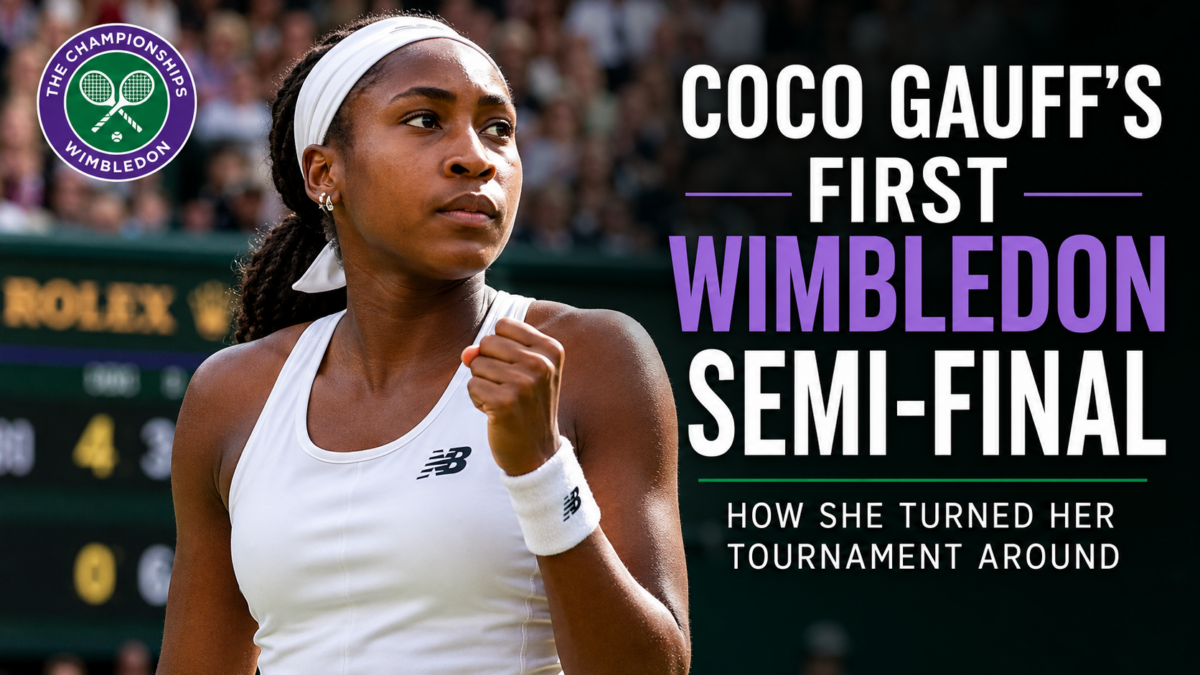
Coco Gauff’s First Wimbledon Semi-Final: How She Turned Her Tournament Around

For years, Wimbledon had been the one Grand Slam where Coco Gauff struggled to make a deep run. Despite winning major titles on hard courts and clay, grass remained her toughest challenge. That narrative changed dramatically at Wimbledon 2026, where the American star reached her first-ever semi-final at the All England Club.

Her journey wasn’t built on flawless tennis. Instead, it showcased resilience, tactical adjustments, and growing maturity. After overcoming several difficult moments throughout the tournament, Gauff proved she can now compete with the very best on every surface.

A Difficult Start That Could Have Derailed Her

Gauff’s quarter-final against fellow American Jessica Pegula perfectly reflected her tournament.

Pegula controlled much of the opening set, forcing Gauff into mistakes with deep, aggressive groundstrokes. Gauff struggled with timing, committing numerous unforced errors and several double faults during the first set. At that stage, another disappointing Wimbledon exit seemed possible.

Instead of forcing winners, Gauff changed her approach.

She became more patient during rallies, improved her first-serve percentage, and relied on her exceptional movement to extend points. That tactical shift completely changed the momentum of the match.

After losing the opening set, Gauff fought back to win 4-6, 6-3, 6-3 and booked her maiden Wimbledon semi-final.

Mental Strength Became Her Biggest Weapon

One of the biggest differences between this year’s Wimbledon and previous appearances was Gauff’s composure.

Rather than becoming frustrated after mistakes, she quickly reset between points and trusted her game plan. Throughout the tournament, she consistently handled pressure better than in previous seasons.

Following her victory over Pegula, Gauff admitted she felt more comfortable on Centre Court than ever before. She explained that, for the first time in years, she wasn’t overwhelmed by the occasion and simply focused on competing point by point.

That confidence allowed her to recover from difficult moments without panicking.

Tactical Adjustments That Changed Everything

Grass courts reward aggressive tennis, but they also punish poor movement and inconsistent serving.

Earlier in her career, Gauff often struggled to adapt her game on grass. During Wimbledon 2026, however, several important improvements stood out.

More Reliable First Serve

Although her serve wasn’t perfect, Gauff significantly improved her first-serve consistency after the early rounds. Winning more free points reduced the pressure on longer rallies.

Smarter Shot Selection

Instead of trying to overpower opponents from difficult positions, Gauff focused on constructing points with patience before attacking shorter balls.

Elite Court Coverage

Perhaps her greatest advantage remained her athleticism.

Few players recover defensive positions as quickly as Gauff. Her speed forced opponents to hit extra shots, increasing their chances of making errors.

These tactical improvements helped transform her from a dangerous outsider into a genuine Wimbledon title contender.

Overcoming the Grass-Court Question

Before Wimbledon began, many experts questioned whether grass would ever become one of Gauff’s strongest surfaces.

Unlike clay or hard courts, grass rewards low bouncing shots, quick reactions, and shorter rallies. Those conditions had previously exposed weaknesses in her forehand consistency and serve.

This tournament suggested those concerns may finally be disappearing.

Even when her shots weren’t perfect, Gauff showed greater adaptability. She accepted that not every point needed spectacular winners. Instead, she relied on discipline, movement, and intelligent shot selection.

That evolution may prove just as valuable as any technical improvement.

The Quarter-Final Victory Was More Than Just Another Win

Defeating Jessica Pegula carried extra significance.

The match featured two of America’s highest-ranked women’s players and represented one of the biggest quarter-final contests of the tournament.

By recovering after losing the first set, Gauff demonstrated the championship mentality that has defined many Grand Slam winners.

The victory also made her the youngest woman in nearly two decades to reach the semi-finals of all four Grand Slam tournaments, highlighting just how rapidly her career continues to develop.

A Semi-Final That Tested Everything

Gauff’s Wimbledon campaign eventually ended in a dramatic three-set semi-final against Karolina Muchová.

Despite fighting back brilliantly after losing the opening set and earning a match point, Gauff narrowly fell in a tense deciding-set tiebreak. Following the match, she said she had “no regrets” about the aggressive decision she made on match point, choosing instead to view the loss as another step in her development.

Although the defeat was heartbreaking, it reinforced an important point: Gauff is no longer simply a hard-court or clay-court threat. She has established herself as a genuine contender on grass as well.

What This Means for the Rest of the Season

Reaching the Wimbledon semi-finals could have lasting benefits beyond this tournament.

The confidence gained from succeeding on her most challenging surface should strengthen her belief heading into future Grand Slam events.

Her improved serving, tactical patience, and mental resilience are qualities that translate across every surface.

If she continues refining those areas, it would not be surprising to see Gauff compete for multiple major titles in the coming years.

FAQs

Why was Wimbledon considered Coco Gauff’s toughest Grand Slam?

Grass courts had historically been her least successful surface because of the faster pace, lower bounce, and shorter reaction time required. Before 2026, she had never reached the Wimbledon semi-finals.

How did Coco Gauff beat Jessica Pegula?

After losing the opening set, Gauff improved her serving, reduced unforced errors, extended rallies, and used her defensive movement to win 4-6, 6-3, 6-3.

What changed in Gauff’s game during Wimbledon 2026?

Her biggest improvements included stronger mental composure, smarter shot selection, a more reliable first serve, and better tactical decision-making under pressure.

Did Coco Gauff reach the Wimbledon final?

No. She reached her first Wimbledon semi-final before losing a dramatic three-set match to Karolina Muchová.

Final Thought

Coco Gauff’s Wimbledon 2026 campaign will be remembered for far more than reaching her first semi-final. It marked the moment she answered long-standing questions about her ability to succeed on grass. Rather than relying solely on athleticism, she displayed tactical maturity, emotional control, and the confidence to recover from difficult situations.

Although her journey ended just short of the final, Gauff left Wimbledon having transformed both her game and the perception of what she can achieve. If this tournament is any indication, future grass-court success is no longer a possibility—it is an expectation.
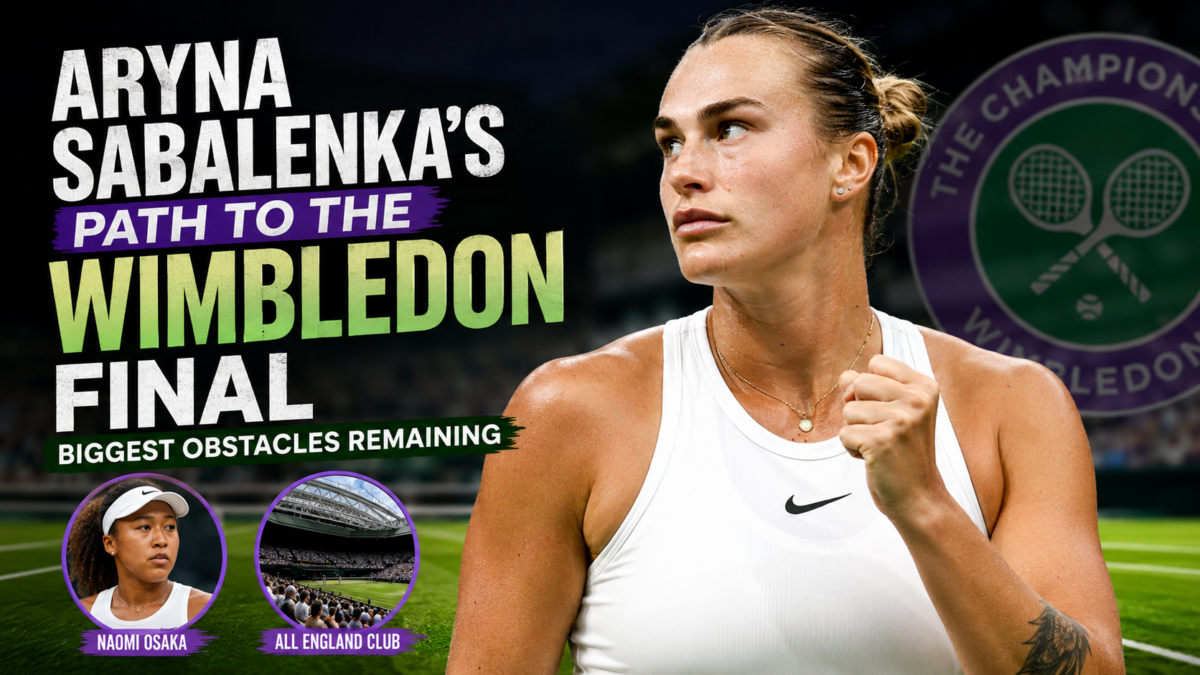

Aryna Sabalenka’s Path to the Wimbledon Final: Biggest Obstacles Remaining

Aryna Sabalenka’s Path to the Wimbledon Final: Biggest Obstacles Remaining

Aryna Sabalenka entered Wimbledon 2026 carrying the weight of expectation. As the world No. 1, she was considered the strongest favorite to capture her maiden Wimbledon title after several deep runs at the All England Club. With early exits from several top contenders, the draw appeared to be opening perfectly for the Belarusian.

However, Grand Slam tournaments rarely follow the script.

Sabalenka’s impressive run came to an unexpected end in the fourth round when former world No. 1 Naomi Osaka produced one of the biggest upsets of the tournament. The result not only ended Sabalenka’s championship dream but also transformed the entire women’s draw.

Why Sabalenka Was the Favorite

Before Wimbledon began, Sabalenka’s form suggested she was ready to conquer grass. She had already enjoyed an outstanding 2026 season with strong performances on hard courts and continued consistency across major tournaments.

Her powerful serve, aggressive baseline game, and improved movement made her one of the toughest opponents on any surface. Wimbledon had previously been a tournament where she reached multiple semi-finals but never lifted the trophy. This year looked like her best opportunity.

As the tournament progressed, several major contenders exited earlier than expected, making Sabalenka the clear player to beat.

A Strong Opening Week

Sabalenka looked comfortable during the opening rounds.

She handled difficult moments with confidence, particularly against McCartney Kessler, where she recovered after facing multiple set points in the second set. That comeback highlighted her resilience under pressure.

Her third-round victory over Jelena Ostapenko was arguably her most complete performance of the tournament. Sabalenka dominated with controlled aggression, serving efficiently while limiting unforced errors.

After that win, many analysts believed she had finally found the perfect balance between power and patience on grass.

The Biggest Remaining Obstacle Was Naomi Osaka

The projected route to the Wimbledon final looked manageable on paper.

Instead, Naomi Osaka produced one of her finest performances since returning to professional tennis.

Osaka immediately took control of the match with fearless shot-making and exceptional serving. She dictated rallies early and prevented Sabalenka from establishing her usual aggressive rhythm.

The first set quickly slipped away from the top seed, and although Sabalenka fought harder in the second set, Osaka remained composed during the tiebreak to complete a straight-set victory.

One remarkable statistic underlined the significance of the result—Osaka snapped Sabalenka’s remarkable 21-match Grand Slam tiebreak winning streak.

What Went Wrong for Sabalenka?

Several factors contributed to Sabalenka’s defeat.

Inconsistent First Serve

Sabalenka relies heavily on free points behind her serve. Against Osaka, her first-serve percentage dropped at crucial moments, allowing Osaka to attack second serves aggressively.

Unforced Errors

Normally, Sabalenka balances risk with controlled aggression. This time, too many forehand mistakes allowed Osaka to gain confidence throughout the match.

Osaka’s Elite Returning

Osaka read Sabalenka’s serve exceptionally well. Instead of simply defending, she consistently turned return games into attacking opportunities.

Momentum Shift

After losing the opening set comfortably, Sabalenka never fully regained momentum. Osaka maintained scoreboard pressure from start to finish, forcing the world No. 1 into uncomfortable positions.

The Draw Opened Up After the Upset

Sabalenka’s elimination dramatically changed Wimbledon 2026.

Instead of facing the tournament favorite, the remaining players suddenly saw an opportunity to reach the final.

Osaka advanced to the quarter-finals before eventually losing to Karolina Muchova, who used her variety, movement, and net play to end Osaka’s impressive run. Meanwhile, Coco Gauff also continued her strong campaign to reach the semi-finals, highlighting just how competitive the women’s draw had become.

The tournament ultimately guaranteed another first-time women’s Wimbledon champion, showing how unpredictable Grand Slam tennis can be.

Lessons Sabalenka Can Take Forward

Despite the disappointment, Sabalenka’s Wimbledon campaign offered several positives.

She once again proved she can consistently reach the latter stages of major tournaments and remains one of the most complete players on the WTA Tour.

Her improved movement on grass, stronger defensive skills, and willingness to construct points rather than relying solely on power suggest she is becoming an even more dangerous all-court player.

The loss to Osaka also exposed areas that can still improve:

  • Higher first-serve consistency under pressure.
  • Better shot selection during momentum swings.
  • Greater adaptability against elite returners.

Given her age and current level, there is every reason to believe Sabalenka will remain among the favorites for future Wimbledon titles.

What This Means for Women’s Tennis

Sabalenka’s defeat reinforces how competitive women’s tennis has become.

Unlike previous eras dominated by one or two players, today’s WTA Tour features several legitimate Grand Slam contenders capable of defeating the world’s best on any given day.

Osaka’s victory demonstrated that rankings alone do not determine outcomes. Experience, confidence, and tactical execution remain just as important on the sport’s biggest stage.

For fans, that unpredictability is exactly what makes Grand Slam tennis so compelling.

FAQs

Why was Aryna Sabalenka considered the Wimbledon favorite?

She entered Wimbledon as the world No. 1 with excellent form throughout 2026, multiple deep Wimbledon runs in previous years, and a favorable draw after several top seeds were eliminated.

Who defeated Aryna Sabalenka at Wimbledon 2026?

Naomi Osaka defeated Sabalenka in straight sets during the fourth round, producing one of the tournament’s biggest upsets.

What was Sabalenka’s biggest challenge during Wimbledon?

Her toughest obstacle turned out to be Osaka’s aggressive returning, powerful serving, and ability to maintain composure during crucial moments.

Can Sabalenka still win Wimbledon in the future?

Absolutely. She remains one of the strongest players on grass and continues to improve her overall game, making her a leading contender in future Championships.

Final Thought

Aryna Sabalenka’s Wimbledon 2026 campaign did not end with the trophy many expected, but it reinforced her status as one of the elite players in women’s tennis. She showcased championship-level tennis for much of the tournament before running into an inspired Naomi Osaka, whose fearless performance reshaped the entire draw. While the dream of a first Wimbledon title will have to wait, Sabalenka leaves London with valuable lessons that could make her even stronger in future Grand Slams. If she can improve her consistency in high-pressure moments and adapt more effectively against aggressive opponents, her quest for the Venus Rosewater Dish is far from over.

Wimbledon 2026 Biggest First-Round Upsets So Far

Wimbledon 2026 Biggest First-Round Upsets So Far

The opening round of Wimbledon 2026 reminded tennis fans why Grand Slam tournaments remain so unpredictable. While several title contenders comfortably booked their places in the second round, a handful of unexpected defeats completely changed the outlook of both the men’s and women’s draws. From seeded stars crashing out to fearless qualifiers producing career-defining performances, the first round delivered plenty of drama at the All England Club.

The biggest shock undoubtedly came when Finnish qualifier Otto Virtanen stunned fourth seed Ben Shelton in an unforgettable five-set battle. However, that wasn’t the only surprise. Several established names failed to handle the pressure, while underdogs embraced the biggest stage of their careers.

If these opening matches are any indication, Wimbledon 2026 could become one of the most unpredictable editions in recent memory.

Otto Virtanen Produces the Tournament’s Biggest Shock

The headline upset belonged to Finnish qualifier Otto Virtanen, who eliminated World No. 4 Ben Shelton after one of the most dramatic matches of the tournament.

Virtanen fought back from difficult moments throughout the contest, eventually winning 6-4, 3-6, 6-7(8), 6-2, 7-6(9) after saving a match point in the deciding-set tiebreak. Shelton appeared only one point away from victory before Virtanen produced fearless tennis under immense pressure.

The victory marked the biggest win of Virtanen’s professional career and instantly became one of the standout moments of Wimbledon 2026.

Why This Upset Matters

Several factors made this result particularly significant:

  • Shelton entered Wimbledon as the fourth seed and one of the strongest grass-court contenders.
  • He reached the quarter-finals last year and was widely considered a genuine title challenger.
  • Virtanen came through qualifying and entered the tournament with little external expectation.
  • Saving a match point before completing the comeback highlighted remarkable mental strength.

For Shelton, another early Grand Slam exit raises questions about consistency in major tournaments despite his enormous talent.

Ben Shelton’s Missed Opportunity

Shelton’s powerful serve and aggressive forehand normally make him extremely dangerous on grass.

Throughout much of the contest, he looked in control and even earned match point in the deciding tiebreak. However, a few costly errors combined with Virtanen’s fearless shot-making completely shifted the momentum.

After the match, Shelton admitted it ranked among the toughest defeats of his career because victory had been within touching distance.

The result also continues a concerning trend of unexpected exits at major tournaments this season.

Underdogs Are Thriving at Wimbledon

One reason Wimbledon continues to captivate tennis fans is the unique challenge of grass courts.

Unlike clay or hard courts, grass rewards players who:

  • Serve aggressively
  • Attack the net
  • Take the ball early
  • Play without hesitation

That often narrows the gap between elite players and qualifiers.

Several lower-ranked competitors entered Wimbledon after strong qualifying campaigns and immediately carried that confidence into the main draw. Their willingness to attack from the opening point caught seeded opponents off guard.

Rather than simply defending, these underdogs dictated rallies and embraced pressure moments.

First Round Delivered Several Unexpected Results

Although Virtanen’s victory dominated headlines, the opening round featured multiple surprising outcomes across both draws.

Some experienced players struggled to adapt to the quick conditions, while rising stars showed remarkable composure on one of tennis’ biggest stages.

According to tournament coverage, Day Two produced multiple seeded casualties, immediately opening sections of the draw that previously appeared highly competitive.

This level of unpredictability is exactly what makes Wimbledon different from many other tournaments.

Pressure of Grand Slam Tennis

Grand Slam events create a unique environment.

Players spend months preparing for Wimbledon, yet one difficult afternoon can end their campaign before it truly begins.

Lower-ranked players often enter with nothing to lose, while top seeds carry enormous expectations.

That psychological difference frequently becomes just as important as technical ability.

Virtanen perfectly demonstrated this mindset. Instead of becoming overwhelmed after losing the third set and facing match point, he continued attacking, trusted his game, and ultimately earned one of the biggest victories of his career.

What These Upsets Mean for the Tournament

Early exits from top seeds dramatically reshape Grand Slam draws.

Shelton’s departure creates a far more open section, offering opportunities for other players to make deep runs.

History shows that once major contenders leave early, momentum can quickly shift toward previously overlooked competitors.

Several dangerous unseeded players now have realistic chances of reaching the second week, making the men’s singles competition even more unpredictable.

As the tournament progresses, confidence may prove more valuable than ranking.


Fans Witness Classic Wimbledon Drama

The opening rounds delivered exactly what tennis fans hope for:

  • Five-set thrillers
  • Emotional celebrations
  • Match-point escapes
  • Career-changing victories
  • Unexpected exits from seeded stars

The atmosphere around the All England Club reflected the excitement, with every upset generating fresh discussion about who could ultimately lift the championship trophy.

If the first round is any indication, Wimbledon 2026 still has many surprises waiting.

Can More Seeds Fall?

With confidence growing among qualifiers and lower-ranked players, additional surprises remain entirely possible.

Grass courts naturally reduce the margin for error.

A few missed break points, one poor service game, or a brilliant tiebreak can completely change the outcome.

Several top contenders have already survived difficult opening matches, showing that no favourite can afford even a slight drop in concentration.

That uncertainty is exactly what makes Wimbledon one of the most exciting tournaments in world tennis.

Final Thoughts

The first round of Wimbledon 2026 has already produced unforgettable moments, but Otto Virtanen’s dramatic victory over Ben Shelton stands above the rest. Saving a match point before defeating one of the tournament favourites perfectly captures the unpredictable nature of Grand Slam tennis.

Beyond one stunning upset, the opening days have shown that rankings alone guarantee nothing on grass. Fearless qualifiers, confident underdogs, and pressure-filled matches have transformed the draw far earlier than expected. As Wimbledon moves into the later rounds, these early surprises have created new opportunities, fresh storylines, and genuine uncertainty over who will eventually lift the famous trophy.

FAQs

Who produced the biggest first-round upset at Wimbledon 2026?

Finnish qualifier Otto Virtanen delivered the biggest surprise by defeating fourth seed Ben Shelton in a thrilling five-set match after saving a match point.

What was the score between Otto Virtanen and Ben Shelton?

Virtanen won 6-4, 3-6, 6-7(8), 6-2, 7-6(9) in one of the tournament’s longest and most dramatic first-round matches.

Why was Ben Shelton’s defeat considered such a major upset?

Shelton entered Wimbledon as the No. 4 seed, one of the tournament favourites, and had previously shown strong grass-court form, making his first-round exit highly unexpected.

Why are upsets common at Wimbledon?

Grass courts reward aggressive tennis, powerful serving, and quick attacking play, allowing lower-ranked players to compete more evenly against top seeds.

How do early upsets affect the Wimbledon draw?

When top seeds are eliminated early, sections of the draw become more open, giving unseeded players and rising stars a greater chance to reach the later rounds.