Cricbet99 Official Website: Understanding Football Odds and Common Betting Markets

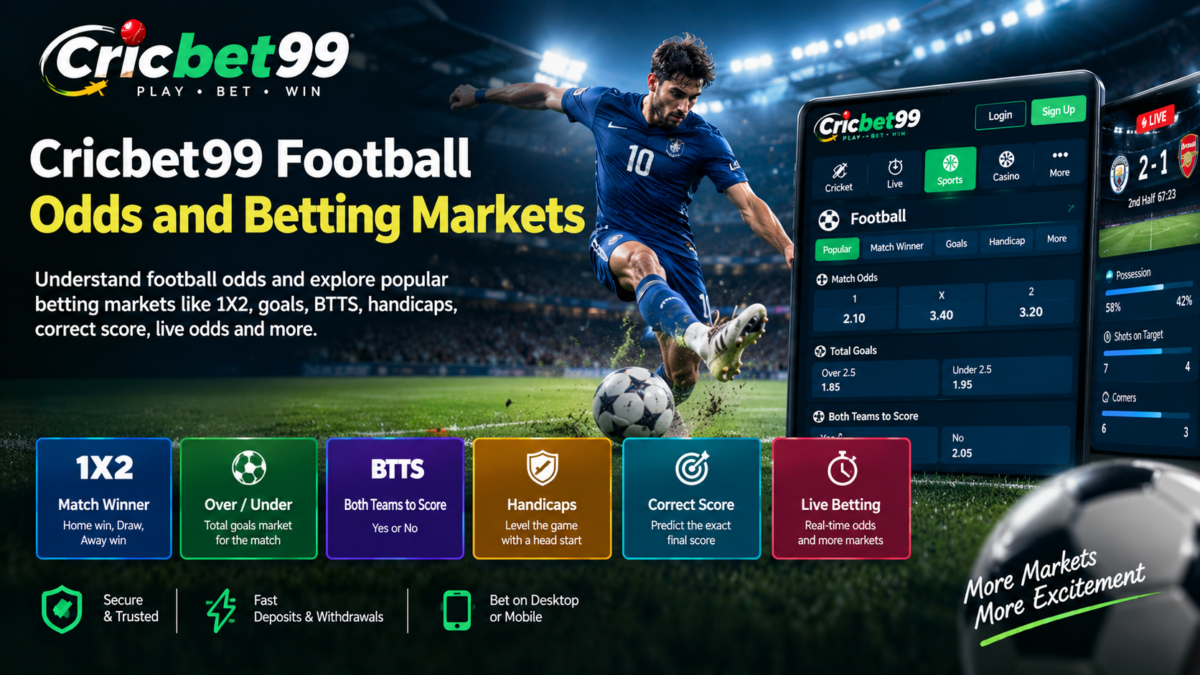
Football betting can look complicated when you first come across different odds, markets, handicaps, totals, and live options. However, most markets are built around a simple idea: assigning a price to a possible outcome.
Understanding how football odds work and what common markets mean can make it much easier to read a betting page. Whether you are checking a match before kick-off or following live action, knowing the difference between the available markets is important.
What Are Football Betting Odds?
Football betting odds represent the price attached to a particular outcome. They also reflect the market’s assessment of how likely that outcome is, although odds should not be treated as a guarantee.
Decimal odds are commonly used because they are relatively easy to understand.
For example, if a team is listed at odds of 2.00 and the stake is ₹500, the potential total return would be ₹1,000 if the selection is settled as a winner.
The calculation is:
Total Return = Stake × Decimal Odds
So:
₹500 × 2.00 = ₹1,000
The potential profit in this example would be ₹500, excluding any applicable conditions or charges.
Lower odds generally indicate that an outcome is considered more likely by the market, while higher odds indicate a less likely outcome. Neither price guarantees what will happen on the pitch.
Why Football Odds Change
Football odds are not necessarily fixed from the moment a market opens.
Before kick-off, prices can move because of factors such as:
- Team news
- Injuries
- Suspensions
- Confirmed line-ups
- Recent performances
- Home and away records
- Competition circumstances
- Market activity
Once the match begins, additional information becomes available. A goal, red card, penalty, injury, substitution, or significant change in the match situation can result in major movement.
This is why live markets can look very different from the prices available before kick-off.
Match Winner or 1X2 Market
The 1X2 market is one of the most common football betting markets.
It contains three basic outcomes:
- 1 — Home team wins
- X — Match ends in a draw
- 2 — Away team wins
Football’s official Laws of the Game state that the team scoring more goals wins, while equal scores result in a draw unless competition rules require a winner through extra time or penalties.
This makes the 1X2 market relatively easy to understand, but settlement can still depend on the specific competition and market rules.
Double Chance Markets
Double Chance markets cover two of the three basic match outcomes.
Typical options include:
- Home win or draw
- Away win or draw
- Home win or away win
The idea is that instead of selecting one specific result, the market combines two possible outcomes.
Because more than one result can satisfy the selection, the odds are generally different from a straightforward match-winner selection.
Draw No Bet
Draw No Bet provides another way to focus on a team’s result while accounting for the possibility of a draw.
If the selected team wins, the selection is successful. If the match ends in a draw, the stake treatment depends on the market’s stated rules. If the selected team loses, the selection does not win.
Always check the individual market’s settlement terms because rules can vary between operators.
Over and Under Goals Markets
Over/Under markets focus on the total number of goals scored in a match.
For example, a market could offer:
Over 2.5 Goals
Under 2.5 Goals
If the match finishes 2-1, there are three goals in total, so the Over 2.5 selection meets its condition.
If the match finishes 1-1, there are two goals, so Under 2.5 meets its condition.
These markets focus on the combined goals scored by both teams rather than identifying the winner.
Both Teams to Score
Both Teams to Score, commonly shortened to BTTS, focuses on whether both sides will score at least once.
The two basic options are:
- Yes
- No
For example, a 2-1 result satisfies BTTS Yes because both teams scored.
A 2-0 result does not satisfy BTTS Yes because only one team scored.
This market can be useful for understanding how a sportsbook separates goal-related outcomes from the match winner.
Asian Handicap and Goal Handicap Markets
Handicap markets introduce a virtual advantage or disadvantage to one side before settlement.
For example, a team could be listed with a -1 handicap, while its opponent receives +1.
The final score is adjusted according to the stated handicap before determining the market result.
Handicap markets can become more detailed, including quarter-goal lines and other variations. Because settlement can be different from a standard winner market, it is important to understand exactly what handicap has been applied.
Correct Score Markets
Correct Score markets require a prediction of the final score.
Possible selections might include:
- 1-0
- 1-1
- 2-0
- 2-1
- 2-2
- 3-1
There can also be an option covering other scores, depending on the sportsbook.
Correct Score markets generally carry higher odds because the exact final score is a narrower outcome than simply selecting the winning team.
Goalscorer Markets
Goalscorer markets focus on individual players.
Depending on the sportsbook and competition, options may include:
- First goalscorer
- Anytime goalscorer
- Last goalscorer
Player availability is particularly important for these markets. A player who does not start, is substituted, or is unavailable can affect how a market is offered or settled.
The exact settlement rules should therefore be checked before placing a selection.
Corners and Cards Markets
Football betting is not limited to goals and match results.
Some sportsbooks also offer markets based on:
- Total corners
- Team corners
- Corner handicaps
- Total cards
- Team cards
- Player cards
These markets depend on specific statistical events during the match. Because different competitions and operators can have different settlement definitions, users should read the market rules carefully.
Live Football Betting Markets
Live betting allows markets to be offered after a match has started.
At this stage, odds can respond to actual match events, including:
- Goals
- Red cards
- Penalties
- Possession
- Match time
- Substitutions
- Current score
- Attacking pressure
Football matches normally consist of two 45-minute halves, with additional time allowed for stoppages under the Laws of the Game.
Because the amount of time remaining changes continuously, live markets can move quickly. Markets can also be temporarily suspended around major events before being reopened with updated prices.
For users comparing different football betting markets, understanding the distinction between pre-match and live markets is an important starting point.
Extra Time and Settlement Rules
Not every football market is settled in exactly the same way when a match goes beyond regular time.
IFAB’s Laws state that when competition rules require a winner after a drawn match or tie, extra time and/or penalties can be used according to the applicable competition regulations.
This is particularly important in knockout competitions.
A market may specify that it covers the result after regular time only, while another may include extra time. Penalty shoot-outs can also have separate settlement conditions.
Always check the market description before assuming how an outcome will be calculated.
What to Check Before Choosing a Market
Before using any football betting market, it is useful to check:
- What exact outcome does the market cover?
- Are the odds decimal or another format?
- Does the market include extra time?
- What happens if the match is abandoned?
- How are substitutions and player non-participation handled?
- Does the market remain active during live play?
- What are the operator’s settlement conditions?
These details can be more important than simply looking at the displayed odds.
Frequently Asked Questions
What are football betting odds?
Football betting odds are prices attached to specific outcomes. They indicate the market’s assessment of an outcome and determine the potential return based on the stake and odds.
What does 1X2 mean in football?
1X2 represents three outcomes: 1 for a home win, X for a draw, and 2 for an away win.
What is Over 2.5 Goals?
It means the market is based on whether the match will contain at least three goals in total.
What does BTTS mean?
BTTS stands for Both Teams to Score. The market generally asks whether both teams will score at least one goal.
Do live football odds change?
Yes. Live odds can change as the score, remaining time, player availability, and other match conditions develop.
Does extra time count in football betting?
It depends on the specific market’s settlement rules. Some markets cover regular time only, while others may include extra time.
Final Thought
Football betting markets cover much more than simply choosing a team to win. From 1X2 and Double Chance to goals, handicaps, correct scores, player markets, corners, cards, and live betting, each market focuses on a different aspect of the match.
Understanding the odds is equally important. A price reflects the market’s assessment of an outcome and can change as new information becomes available. It should never be treated as a guarantee.
For anyone using a sports betting platform, reading the market description and settlement rules before making a selection is essential. Football remains unpredictable, and responsible betting means understanding the risks, following applicable laws, and setting sensible limits.