What Is the Half-Time/Full-Time Betting Market?

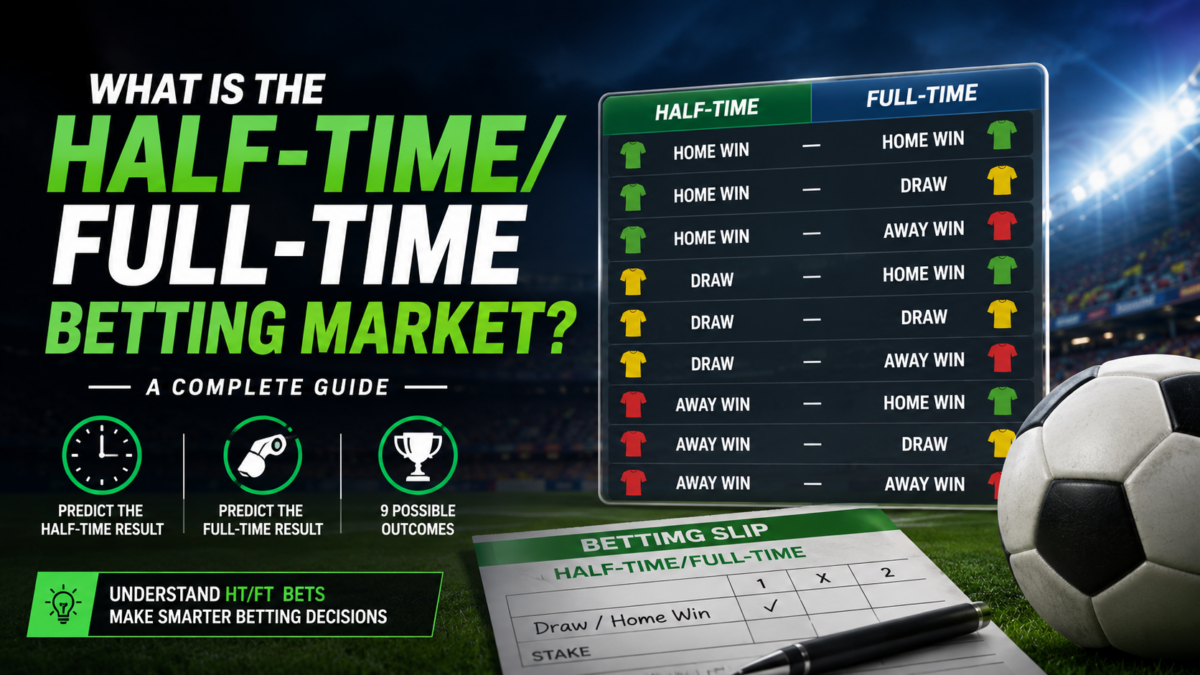
Football betting offers far more options than simply predicting which team will win. One market that attracts attention because it combines two different stages of a match is the half-time/full-time betting market, commonly called HT/FT betting.
Instead of predicting only the final result, this market asks you to predict what the score or result will be at half-time and then what the final result will be after the second half. That makes it different from a standard match-winner bet and gives football fans another way to approach a game.
For anyone new to football betting, understanding how HT/FT markets work is important before considering them. Here is a straightforward guide to the market, its possible outcomes, and the factors that can influence a result.
How Does Half-Time/Full-Time Betting Work?
A half-time/full-time bet requires two predictions.
The first prediction concerns the result at the end of the first half. The second concerns the result at the end of the full match.
For example, imagine a match between Manchester United and Arsenal. A bookmaker may offer the following HT/FT combinations:
- Manchester United / Manchester United
- Manchester United / Draw
- Manchester United / Arsenal
- Draw / Manchester United
- Draw / Draw
- Draw / Arsenal
- Arsenal / Manchester United
- Arsenal / Draw
- Arsenal / Arsenal
The first selection represents the half-time result, while the second represents the final result.
So, if someone selects Draw/Arsenal, Arsenal must not be leading at half-time. The match must be level after the first 45 minutes, while Arsenal must win by the end of the match.
This is why HT/FT betting can be more demanding than simply predicting the eventual winner.
What Do the HT/FT Symbols Mean?
Most sportsbooks use three basic result options for each period:
- H – Home team
- D – Draw
- A – Away team
Combining those three options creates nine possible HT/FT outcomes.
For example:
H/H: The home team is ahead at half-time and wins the match.
H/D: The home team leads at half-time, but the match finishes level.
H/A: The home team leads at half-time but eventually loses.
D/H: The match is level at half-time and the home team wins in the second half.
D/D: The match is level at half-time and remains a draw at full-time.
D/A: The match is level at half-time before the away team wins.
A/H: The away team leads at half-time but loses the match.
A/D: The away team leads at half-time but the game eventually ends in a draw.
A/A: The away team leads at half-time and goes on to win.
Understanding these combinations makes it much easier to read a betting slip or sportsbook market.
Why Is HT/FT Betting Different From a Normal Match-Winner Bet?
A standard match-winner market generally focuses on one question: who will win the game?
HT/FT betting adds another layer because the first-half result also matters.
Consider a team that is expected to be stronger overall but tends to start matches slowly. Backing that team in a traditional match-winner market may still make sense based on its overall strength. However, choosing Home/Home in an HT/FT market requires the team to be ahead after the first half as well.
That distinction can significantly change the risk and potential return associated with the selection.
The market therefore encourages bettors to think about how a match may develop, rather than looking only at the final score.
What Factors Matter in HT/FT Betting?
Several factors can be useful when analysing an HT/FT market.
1. First-Half Performance
Look at how teams usually start their matches. Some sides regularly score early, while others become more effective after half-time.
Recent first-half results can provide useful context, although past performances do not guarantee future results.
2. Second-Half Record
A team’s ability to change the game after the break is particularly important. Some teams have strong second-half records because of tactical adjustments, substitutions, fitness levels, or their ability to maintain pressure.
3. Tactical Approach
Managers can have a major influence on how a match develops. A team may begin cautiously before becoming more aggressive later, while another may attempt to establish an early advantage and then defend it.
4. Injuries and Suspensions
Missing key players can affect both halves differently. A team without its main attacking player may struggle to create chances early, while a missing defender could become more significant as the match progresses.
5. Home and Away Form
Home advantage and away performance can also provide useful background information. However, they should be considered alongside current form, team news, and the quality of the opposition rather than used in isolation.
A Simple Example of HT/FT Betting
Suppose Team A plays Team B.
At half-time, the score is 0-0. Team A then scores twice in the second half and wins 2-0.
For this match, the HT/FT result would be:
Draw/Team A
If a bettor had selected Draw/Team A, both parts of the prediction would have been correct.
Now imagine Team A scores first and leads 1-0 at half-time but Team B comes back to win 2-1.
The HT/FT result would then be:
Team A/Team B
The final score alone does not tell the complete HT/FT story. The result at half-time is equally important.
How Is HT/FT Different From Half-Time Result Betting?
The two markets are related but not identical.
A half-time result bet only predicts what happens during the first half. Once the half-time whistle is blown, the market is settled.
An HT/FT bet, on the other hand, requires two correct predictions: the half-time outcome and the final outcome.
That makes HT/FT a more specific market because a correct final winner is not enough. The half-time prediction must also be correct.
Football matches consist of two 45-minute periods under the standard Laws of the Game, with allowance made for time lost. The half-time interval is normally no more than 15 minutes.
What Should Beginners Look For?
Beginners should first make sure they understand exactly what each selection means before placing a bet. It is easy to confuse a half-time prediction with a full-time prediction when several markets appear on the same betting page.
It can also help to compare relevant statistics rather than relying purely on a team’s reputation. Recent first-half results, goals scored and conceded before the break, second-half performances, home and away records, and confirmed team news can all contribute to a more informed assessment.
For readers exploring broader sports betting markets, platforms such as CricBet99 can also be useful for understanding how different betting categories are presented. The key is to understand the market first rather than selecting an outcome simply because its odds look attractive.
Common Mistakes in HT/FT Betting
One common mistake is focusing too heavily on the expected final winner.
A strong team may be expected to win but could still be level or behind at half-time. In that situation, a simple match-winner prediction and an HT/FT prediction produce very different requirements.
Another mistake is ignoring a team’s first-half tendencies. If a side frequently starts slowly, selecting it to lead at half-time requires more careful consideration.
It is also worth remembering that odds are not guarantees. Football is unpredictable, and an early goal, red card, injury, penalty, or tactical change can completely alter the direction of a match.
Frequently Asked Questions
What does HT/FT mean in football betting?
HT/FT stands for Half-Time/Full-Time. It requires a prediction of the result at half-time and another prediction for the final result.
How many HT/FT outcomes are there?
There are normally nine possible combinations, based on home win, draw, or away win at half-time and full-time.
What does Draw/Team mean in HT/FT betting?
It means the match must be level at half-time, while the selected team must win by full-time.
Is HT/FT betting the same as match-winner betting?
No. A match-winner bet focuses on the final result, whereas HT/FT betting requires both the half-time and final results to be correct.
Can a team lose an HT/FT bet even if it wins the match?
Yes. For example, if you select Home/Home but the home team is losing at half-time and eventually wins, the final winner is correct but the HT/FT prediction is wrong.
What statistics are useful for HT/FT analysis?
First-half goals, first-half results, second-half performance, recent form, home and away records, injuries, suspensions, and tactical patterns can all provide useful context.
Final Thought
The half-time/full-time betting market adds an extra dimension to football betting by focusing on the story of the match rather than only its final outcome. It requires bettors to consider how teams perform before and after the break and how tactical changes, form, and match circumstances can influence the result.
The most important point is to understand the market before making a selection. A team being the likely winner does not automatically make every HT/FT combination a sensible choice. Looking at first-half trends, second-half performances, team news, and the wider context can lead to a more structured assessment.
As with any betting market, there is no guaranteed outcome. HT/FT betting is best approached as a market to understand and analyse carefully, rather than one where a particular result should be expected simply because it appears likely on paper.